
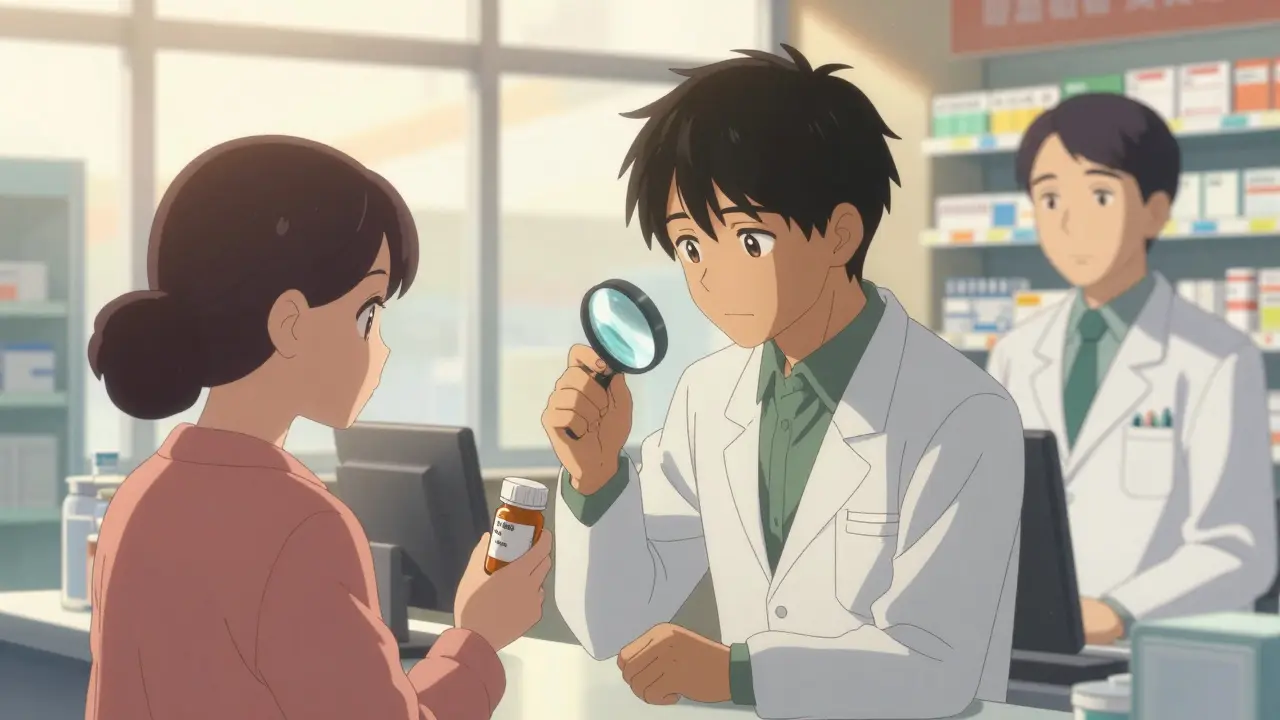
Every year, over a million people in the U.S. are harmed by mistakes in their prescriptions. That’s not a rare accident-it’s a preventable problem. And the person standing at the pharmacy counter with your medication? You’re the last line of defense. Most people grab their pills and leave. But if you take just three minutes to check a few key details, you could stop a dangerous error before it starts.
Why Your Check Matters More Than You Think
Pharmacists are trained professionals. They use barcode scanners, electronic records, and double-check systems. But even with all that tech, mistakes still happen. CMS data from 2022 shows that nearly 13% of pharmacy claims had errors that could have been caught if the patient had asked a simple question. And when patients actively verify their prescriptions, error rates drop by up to 37%. It’s not about trusting or doubting your pharmacist. It’s about adding a safety layer. Think of it like checking your seatbelt after you get in the car. You don’t assume it’s fine-you just check.The 7-Point Prescription Verification Checklist
Here’s what you need to verify before you walk out the door. Go through each one slowly. Don’t rush.- Confirm your name and date of birth - The label must match your legal name exactly. No nicknames. No initials. And your date of birth must be correct. This is the #1 way to catch a mix-up. One in five errors happen because someone got another patient’s prescription.
- Check the medication name - Is it spelled right? Does it match what your doctor told you? If your doctor prescribed Metformin, but the bottle says Metoprolol, that’s a serious mismatch. Generic names can be confusing. Ask: “Is this the same as what my doctor ordered?”
- Verify the strength and dosage - If your doctor prescribed 500 mg, but the bottle says 1000 mg, that’s a double dose. Dosage errors are the most common type of mistake, making up over a third of all prescription errors. Look for numbers like “5 mg,” “10 mg,” or “250 mg.” Don’t assume “one pill” is right-check the number.
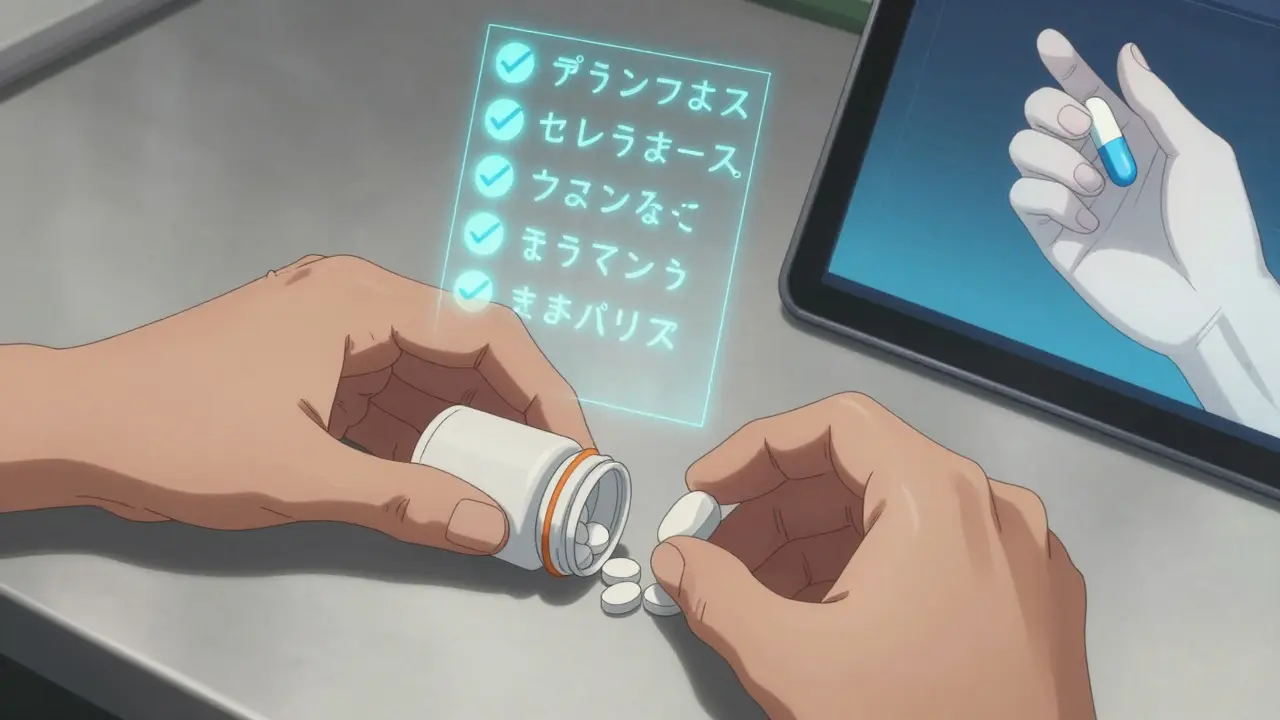
- Count your pills - If you were supposed to get 30 pills, count them. Don’t just trust the label. About 23% of quantity errors are caught only when patients count. Missing pills? Extra pills? Both are red flags. If it’s a liquid or inhaler, check the volume or number of doses.
- Read the instructions - “Take one by mouth twice daily” sounds simple. But what does “twice daily” mean? Morning and night? Every 12 hours? If the label says “q.d.” or “b.i.d.,” ask what that means. Pharmacists see 19% of errors come from unclear instructions. Don’t be shy-ask them to explain it in plain English.
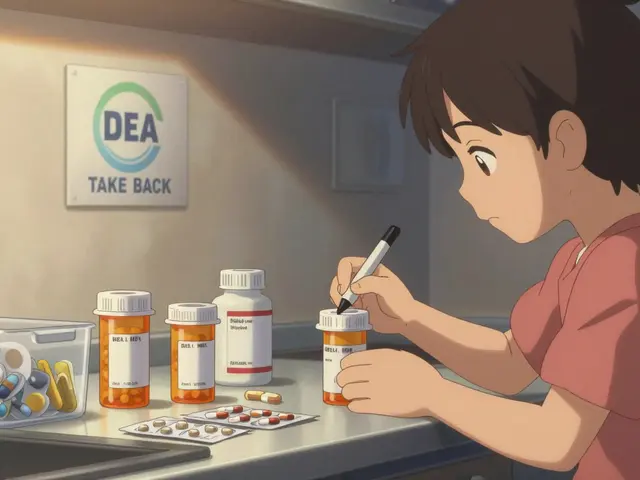
- Check the expiration date and packaging - Is the bottle sealed? Are the pills discolored or crumbling? Is the expiration date more than a year away? Expired or damaged meds can be ineffective or even harmful. About 4% of recalled drugs reach patients because no one checked the date.
- For controlled substances (like opioids or ADHD meds) - Ask: “Is this the correct prescription?” Pharmacists are required to verify your address and confirm the prescription is valid. If you’re getting a refill on a controlled drug, make sure the pharmacy didn’t accidentally give you someone else’s prescription.
What to Do If Something Feels Off
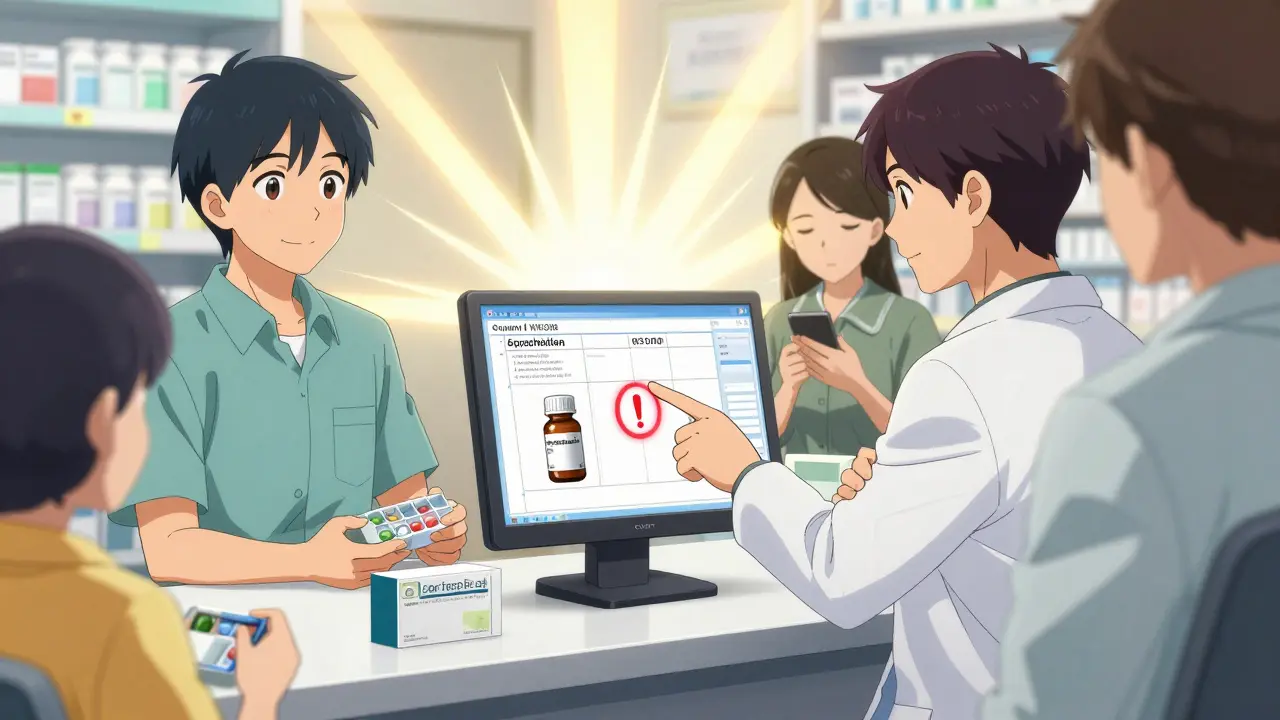
You’re not overreacting if something doesn’t look right. Here’s what to do:- Ask the pharmacist to pull up your original prescription on the computer. Most have it on screen.
- Request to see the bottle before it’s labeled. One patient caught a blood pressure mix-up this way-the pharmacist admitted they almost gave her someone else’s meds.
- If you’re told, “It’s fine,” or “We’ve done this a thousand times,” don’t back down. You’re not being difficult-you’re being safe.
CMS surveys show that 63% of patients who raised concerns were dismissed. That’s unacceptable. If you’re treated poorly for asking questions, report it. Pharmacies with higher patient satisfaction scores are 3.7 times more likely to encourage verification.
Common Problems and How to Solve Them
Not everyone finds this easy. Here are the biggest hurdles-and how to beat them:- Small print on labels - If you’re over 65, you’re not alone. Over 64% of seniors struggle to read pharmacy labels. Ask for a magnifying glass. Most pharmacies keep them behind the counter. Or use your phone’s camera to zoom in.
- Generic vs. brand names - If your doctor wrote “Lisinopril,” but you’ve always taken “Zestril,” you might think it’s wrong. It’s not. Generics have different names but the same active ingredient. Ask: “Is this the same medicine, just a different name?”
- Time pressure - Pharmacies are busy. But you’re not asking for special treatment-you’re asking for basic safety. Say: “I just need a minute to check this. It’s important.” Most pharmacists will pause.
- Confusing abbreviations - “QID,” “PRN,” “TID”-these aren’t everyday words. Ask: “Can you write that out in full?”
What’s Changing in Pharmacies Right Now
The system is improving. By late 2023, nearly all U.S. pharmacies use barcode scanners that check the drug, dose, and patient before dispensing. That’s cut identification errors by over 80%. Some CVS and Walgreens locations now have tablet stations where you can scan your prescription and see a picture of the pill before you pick it up. The FDA now requires every prescription bottle to have a product identifier with the NDC number, serial number, lot number, and expiration date. You can look up the NDC number on the FDA’s website to confirm it matches your drug. And the economics are clear: every $1 spent on patient verification saves $8.73 in avoided hospital visits and emergency care. That’s why pharmacies are now incentivized to get this right.What You Can Do Today
You don’t need to be a medical expert to prevent a medication error. Just remember these three things:- Always check your name, the drug name, and the strength.
- Count your pills or check your liquid dose.
- Ask two questions: “What is this for?” and “What should I do if I miss a dose?”
That’s it. No fancy tools. No apps. Just your eyes, your questions, and your right to be safe.
Medication errors don’t happen because someone is lazy. They happen because the system is complex-and we assume someone else is watching. But you’re the one who takes the pill. So make sure it’s the right one.
What should I do if I find an error on my prescription label?
Don’t take the medication. Ask the pharmacist to double-check the original prescription from your doctor. Most pharmacies will re-check the order, contact your doctor if needed, and provide the correct medication at no extra cost. If they refuse or seem dismissive, ask to speak to the pharmacy manager or file a report with your state board of pharmacy.
Can I verify my prescription if I’m using a mail-order pharmacy?
Yes. When your mail-order prescription arrives, open the package immediately. Check the label against your doctor’s instructions. Count your pills. Look for the NDC number and expiration date. If anything looks wrong, call the pharmacy right away. Mail-order errors happen more often than in-person visits-about 1.7 errors per 100 prescriptions versus 1.2. Don’t assume it’s correct just because it came in the mail.
Is it okay to ask the pharmacist to show me the bottle before they label it?
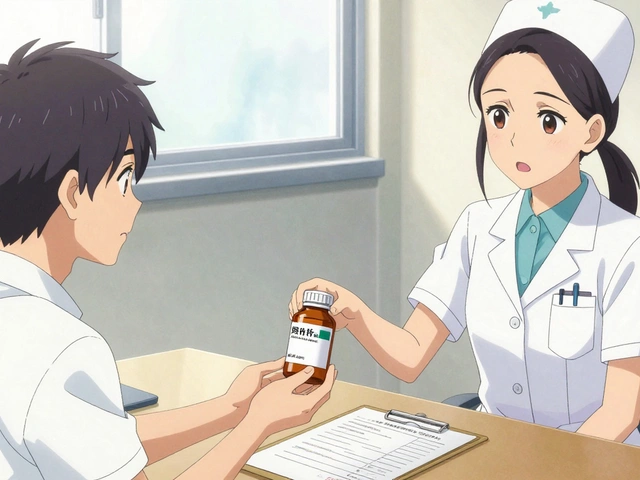
Absolutely. Many pharmacists will pull the unmarked bottle out of the bin to show you the medication before putting it in your labeled container. This is a standard safety practice. If they say no, ask why. A good pharmacy will welcome this step-it’s part of their job.
What if I don’t understand the instructions on the label?
Never guess. Ask the pharmacist to explain it in simple terms. Say: “Can you tell me when and how to take this?” Write it down if you need to. If the label says “take as needed,” ask: “What does ‘as needed’ mean for this medicine?” Some drugs need to be taken with food, others on an empty stomach. Getting this wrong can make the drug ineffective or cause side effects.
Should I keep a list of my medications?
Yes. Keep a current list of every medication you take-including dosages, how often, and why. Update it every time you get a new prescription or stop one. Bring it to every doctor’s visit and pharmacy visit. This helps catch duplicate prescriptions, dangerous interactions, and errors. Many patients don’t realize they’re taking two drugs that shouldn’t be mixed until it’s too late.
Are generic medications safe to take?
Yes. Generic drugs contain the same active ingredient, strength, and dosage form as brand-name versions. They’re required by the FDA to work the same way. The only differences are in color, shape, or inactive ingredients-which don’t affect how the drug works. But always check that the generic name matches what your doctor prescribed. If you’re unsure, ask: “Is this the same as [brand name]?”
What if I’m on multiple medications? How do I avoid mixing them up?
Use a pill organizer labeled with days and times. Ask your pharmacist if they offer pre-filled blister packs-many do for patients on multiple meds. Always check each bottle individually, even if they look similar. Don’t rely on color or shape. One patient mixed up her heart medication with her cholesterol pill because both were small white pills. The difference was in the dosage-and she only caught it because she counted.
This is the kind of post that makes me want to scream at people who just grab their pills and walk out. Over a million harmed every year? That’s not a statistic-that’s a national disgrace. I’ve seen my aunt nearly die because she didn’t check her blood thinner dosage. The pharmacist said ‘it’s fine.’ It wasn’t. Now she’s on kidney dialysis. Don’t be that person. Check your damn label. It’s not hard. It’s not rude. It’s survival.
And if a pharmacist rolls their eyes? Walk out. Find another one. Your life is not their inconvenience.
It is imperative that the general populace recognize the gravity of pharmaceutical misidentification. The United States, despite its technological prowess, continues to exhibit systemic vulnerabilities in its dispensing infrastructure. The data cited herein, while statistically valid, underscores a cultural failure: the abdication of personal responsibility in favor of institutional trust. One must not rely upon the competence of others when one's own life is at stake. Verification is not an option-it is a civic duty. The pharmacists, though trained, operate under duress, understaffing, and time constraints. The onus, therefore, must rest upon the patient. Failure to do so constitutes negligence on the part of the individual, not the institution.
Thank you for this clear and necessary guidance. In Nigeria, we often face the opposite problem-medications are unavailable or counterfeit. But even here, when someone does get the right medicine, no one checks the label. I have seen elderly relatives take the wrong pills because the bottle looked similar. This checklist should be printed and posted in every pharmacy, every clinic, every community center. We must normalize asking questions. It is not disrespect-it is wisdom. And if a pharmacist refuses to help, it is the system that has failed, not the patient.
Let us teach our children to verify, not just to trust.
So many people in India don’t even know what the drug name means. My uncle took ‘Atorvastatin’ thinking it was for diabetes because the bottle had a red cap-same as his sugar pills. He ended up in the hospital. This list should be translated into every regional language. And maybe someone should make a simple audio guide for people who can’t read. No one should die because they couldn’t read small print.
I always count my pills and check the date
my eyes are bad so I use my phone to zoom
pharmacist always says thanks
it’s weird that people don’t do this
it’s funny how we trust machines to drive us and algorithms to pick our dating matches but when it comes to something that could kill us we just hand over a slip of paper and walk away
we’ve outsourced our responsibility to institutions that are overworked and underfunded
but the pill doesn’t care if your pharmacist had a bad day
it just does what it’s made to do
and if it’s the wrong one… well
that’s on you
not the system
not the pharmacist
you
you’re the one who swallows it
This is not just a checklist-it is a manifesto for patient dignity. In India, we have a culture of deference to authority. We do not question doctors, nurses, or pharmacists. But medicine is not a religion. It is a science, and science demands verification. I have trained dozens of community health workers to teach this checklist to senior citizens in rural villages. We use pictures, audio recordings, and local dialects. The results? A 72% reduction in reported medication errors in our pilot zones. This is not a luxury. It is a right. Every citizen deserves to know what they are taking. And every pharmacist should be proud to be asked.
I used to be the guy who just grabbed his meds and left. Then my mom had a bad reaction to a generic version she didn’t know was different. She didn’t even realize it until she started feeling dizzy. I felt awful. Now I check everything. I even take a picture of the label before I leave. No one’s ever mad. Most pharmacists are actually relieved someone’s paying attention. It’s not about being paranoid. It’s about being smart. And honestly? It’s kind of empowering. Like, yeah-I’m the one who takes this. I get to make sure it’s right.