

Every year, millions of people reach for ibuprofen or naproxen to ease a headache, back pain, or menstrual cramps. They’re on the shelf next to aspirin and acetaminophen, easy to grab, and seem harmless. But here’s the truth: ibuprofen and naproxen aren’t just harmless pain relievers. They carry real, documented risks - and most people have no idea how serious they are.
What You’re Actually Taking
Ibuprofen and naproxen are both NSAIDs - nonsteroidal anti-inflammatory drugs. They work by blocking enzymes that cause pain and swelling. But they don’t just turn off pain signals. They also interfere with protective chemicals in your stomach, kidneys, and blood vessels.Over-the-counter ibuprofen comes in 200 mg tablets. That’s the standard dose you’ll find in bottles labeled Advil or Motrin. Naproxen sodium is sold as 220 mg tablets - the OTC version of Aleve. Sounds simple, right? But here’s where it gets dangerous: people think because it’s sold without a prescription, it’s safe to use like candy.
Maximum daily limits exist for a reason. For ibuprofen, it’s 1,200 mg per day - that’s six 200 mg tablets. For naproxen, it’s 600 mg per day - three 220 mg tablets. Yet, a 2023 survey by the National Community Pharmacists Association found that 63% of people didn’t even know the 10-day limit for OTC NSAIDs. Many take them for weeks, thinking it’s fine as long as they don’t feel sick.
The Hidden Risks You’re Ignoring
The FDA updated its warning in October 2020 after reviewing data from over 1.9 million patients. The message was clear: NSAIDs can trigger heart attacks and strokes - and the risk starts as early as the first week of use.It’s not just about long-term use. A March 2024 study in The Lancet found that even taking recommended doses for under 7 days raised heart attack risk by 20% in people with existing heart conditions. That’s not theoretical. That’s real data from 10 million patients.
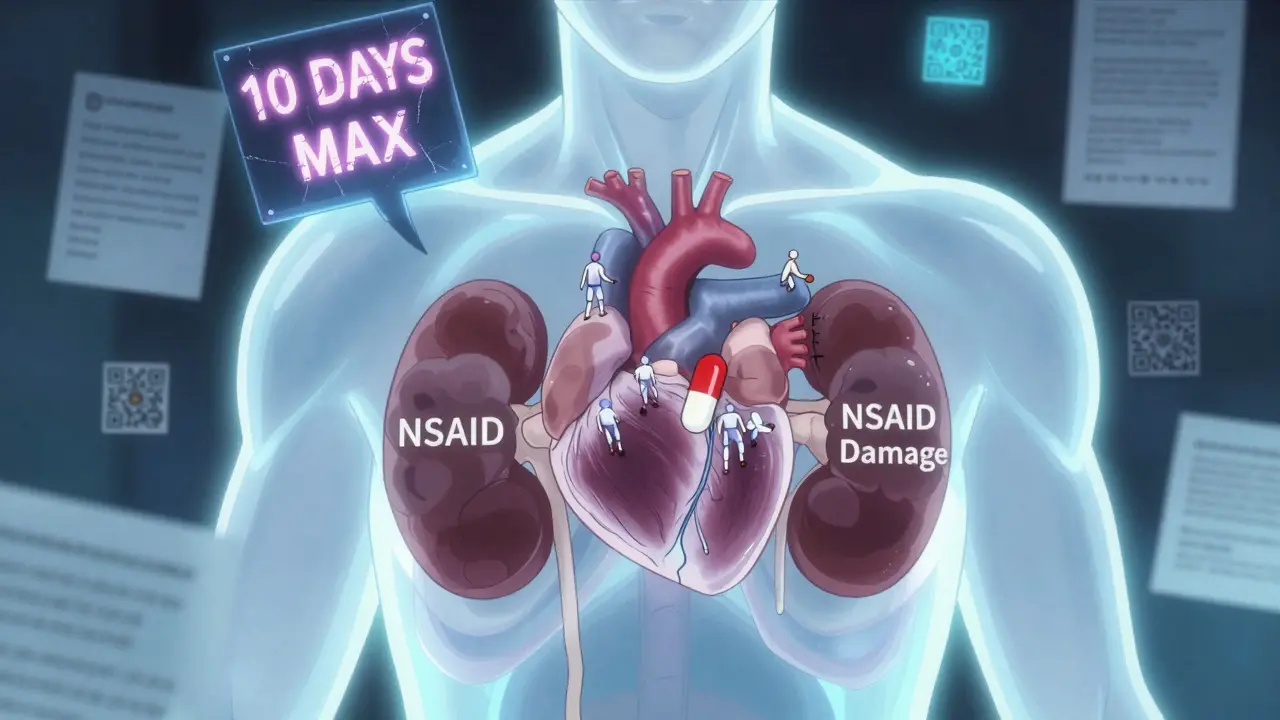
And it’s not just your heart. NSAIDs reduce blood flow to your kidneys. If you’re older, dehydrated, or already have kidney issues, this can lead to acute kidney injury. The FDA Adverse Event Reporting System recorded a case in early 2024 where a 68-year-old patient developed kidney failure after taking the maximum dose of naproxen for 14 days straight - just one week past the recommended limit.
Then there’s your stomach. NSAIDs increase your risk of ulcers and internal bleeding by 2 to 4 times compared to people who don’t take them. A Reddit user shared a story in March 2024 about being hospitalized after taking 1,600 mg of ibuprofen daily for three weeks. He didn’t feel pain until he started vomiting blood. That’s not an outlier. It’s common.
Ibuprofen vs. Naproxen: Which Is Safer?
People often ask: which one should I pick? The answer isn’t simple.Naproxen has a longer half-life - 12 to 17 hours - meaning you take it less often. That might seem convenient, but it also means the drug stays in your system longer, increasing exposure. Ibuprofen wears off in 2 hours, so you take it more frequently. That can lead to accidental overdosing if you’re not careful.
When it comes to heart risk, naproxen has a slight edge. A 2015 FDA review of data from 2004 to 2014 found naproxen had the most favorable cardiovascular profile among NSAIDs. A 2017 study in the British Medical Journal tracking 635,000 patients found high-dose ibuprofen increased heart failure risk by 61%, while naproxen raised it by only 20%.
But here’s the twist: naproxen is worse for your stomach. Research in Gastroenterology (2019) showed that at anti-inflammatory doses, naproxen causes more gastrointestinal bleeding than ibuprofen. So if you have a history of ulcers or acid reflux, ibuprofen might be the lesser evil - if you take it with food and stick to the lowest dose.
Neither is safe. Both carry risks. The best choice is the one you take for the shortest time possible.

Who Should Avoid These Drugs Altogether?
There are nine groups the FDA and Mayo Clinic warn to avoid NSAIDs entirely:- People with heart disease or high blood pressure
- Those with a history of stomach ulcers or bleeding
- People with kidney disease
- Anyone taking blood thinners like warfarin or aspirin
- Adults over 65
- Pregnant women after 20 weeks (can cause low amniotic fluid and fetal kidney damage)
- People with asthma triggered by painkillers
- Those with liver disease
- Children and teens with viral infections (risk of Reye’s syndrome with aspirin - but NSAIDs aren’t much safer for kids without doctor approval)
If you fall into any of these categories, acetaminophen (paracetamol) is usually the safer alternative. But even acetaminophen has limits: 3,000 mg per day max to avoid liver damage. And it doesn’t reduce inflammation - only pain and fever.
How to Use Them Without Hurting Yourself
If you decide to use ibuprofen or naproxen, follow these rules - no exceptions:- **Take the lowest dose that works.** Don’t start with 400 mg if 200 mg does the job.
- **Never exceed the daily limit.** Ibuprofen: 1,200 mg. Naproxen: 600 mg. Period.
- **Don’t use longer than 10 days without talking to a doctor.** If pain lasts past that, it’s not a simple headache or muscle strain. It’s a sign something else is wrong.
- **Always take with food.** Even if you don’t feel stomach upset, the damage is happening silently.
- **Avoid alcohol.** It increases bleeding risk and stresses your liver and stomach.
- **Check other meds.** Many cold, flu, and sleep aids contain NSAIDs or acetaminophen. You could accidentally double-dose.
- **Don’t combine with aspirin.** If you take low-dose aspirin for heart protection, ibuprofen can block its effect. Take aspirin at least 30 minutes before ibuprofen - or better yet, ask your doctor for a safer option.
And if you’re using these for chronic pain - back pain, arthritis, migraines - you’re using them wrong. The CDC’s 2022 guidelines say non-drug treatments like physical therapy, heat, exercise, and mindfulness should come first. NSAIDs are a temporary bandage, not a solution.
What People Are Saying - And Why It Matters
On Drugs.com, ibuprofen has a 6.2/10 rating from over 1,800 reviews. 45% say it works. 32% say it gave them stomach pain. Naproxen scores 5.8/10. Same pattern.One review reads: “200 mg ibuprofen with food fixes my cramps perfectly.” Another: “Took 800 mg daily for months for back pain. Ended up with ulcers. Hospital stay.”
The difference? One person followed the rules. The other didn’t. And the consequences were life-altering.
What’s Changing in 2026
Topical NSAIDs like diclofenac gel are becoming more popular. They deliver pain relief directly to the skin with far less systemic exposure - meaning lower risk of stomach, heart, and kidney damage. The Mayo Clinic now recommends them for localized pain like knee or shoulder arthritis.Pharmacies are starting to put stronger warnings on NSAID packaging. Some now include QR codes linking to safety videos. The FDA’s Sentinel Initiative continues monitoring real-world data, and early 2024 findings still point to naproxen having a slightly better cardiovascular profile - but not enough to call it safe.
The bottom line? OTC doesn’t mean risk-free. These drugs are powerful. They’re not candy. They’re not harmless. And if you’re using them regularly, you’re gambling with your health.
Can I take ibuprofen every day for my arthritis?
No. Daily use of ibuprofen for arthritis increases your risk of stomach ulcers, kidney damage, and heart problems. The FDA recommends using the lowest dose for the shortest time possible. For chronic arthritis, talk to your doctor about safer long-term options like physical therapy, weight management, or prescription medications with better safety profiles.
Is naproxen safer than ibuprofen for my heart?
Based on FDA and medical research, naproxen appears to carry a lower cardiovascular risk than ibuprofen - especially at higher doses. A 2015 FDA review and a 2017 BMJ study both found naproxen had the most favorable heart safety profile among common NSAIDs. But it’s not risk-free. Both drugs raise your chance of heart attack and stroke, especially if you already have heart disease. Never assume one is "safe" - use only when necessary and at the lowest dose.
Why can’t I take NSAIDs if I’m pregnant?
After 20 weeks of pregnancy, NSAIDs can cause serious harm to the developing baby. They reduce blood flow to the fetal kidneys, which can lead to low amniotic fluid (oligohydramnios). This can affect lung development and cause complications during delivery. The FDA requires this warning on all NSAID labels. Acetaminophen is generally considered safer during pregnancy, but always check with your doctor before taking any medication.
Can I take ibuprofen with aspirin for heart protection?
Taking ibuprofen with low-dose aspirin can block aspirin’s protective effect on your heart. Ibuprofen interferes with how aspirin works to prevent blood clots. If you take aspirin daily for heart health, avoid ibuprofen. Use acetaminophen instead for pain, or take aspirin at least 30 minutes before ibuprofen if you must use both. Always talk to your doctor first.
What should I do if I’ve been taking NSAIDs for weeks without realizing the risks?
Stop taking them immediately. If you’ve been using them daily for more than 10 days, especially if you’re over 65, have high blood pressure, or kidney issues, see your doctor. Ask for a check-up for stomach bleeding, kidney function, and blood pressure. You may need tests you didn’t know you needed. Most people feel fine - until they don’t. Early detection can prevent serious damage.
Are there safer alternatives to ibuprofen and naproxen?
Yes. For mild pain, acetaminophen (paracetamol) is often safer - as long as you don’t exceed 3,000 mg per day. For localized pain like a sore knee or shoulder, topical NSAID gels (like diclofenac) reduce systemic exposure. Non-drug options like heat packs, physical therapy, stretching, and weight loss can be more effective long-term than pills. For chronic pain, the CDC recommends these approaches first - before any medication.



Wow, this is one of those posts that makes you pause and actually think-like, I’ve taken ibuprofen like candy for years, and now I’m realizing I’ve been playing Russian roulette with my kidneys and heart. I’m not even 40, and I already feel like I’ve been dumb. Thanks for the wake-up call.
While the information presented is both accurate and clinically significant, I must emphasize that the casual tone of over-the-counter medication use reflects a broader cultural disregard for pharmacological nuance. The normalization of NSAID consumption as a lifestyle choice-rather than a targeted, time-limited intervention-represents a systemic failure in public health literacy.
Ugh. Americans. You take a pill for everything-even the pain of not exercising, not sleeping right, or not eating real food. In Canada, we at least have the decency to suffer quietly and then see a doctor. You people treat ibuprofen like it’s a snack. And now you’re surprised your insides are falling apart? Classic.
bro i took 800mg of ibuprofen every day for 6 months for my lower back and i never felt a thing until i woke up puking blood-like, literally no warning. hospital stay, endoscopy, they said if i waited another week i could’ve bled out. i’m 28. this shit is real. if you’re reading this and you’re still popping these like m&ms-stop. just stop.
Man, I used to pop naproxen like it was gum. Now I use heat wraps, stretch every morning, and actually sleep on a real mattress. Pain’s still there sometimes-but now it’s just a reminder to take care of myself, not a signal to grab a pill. Life’s better without the chemical crutch.
It’s not just about the drugs-it’s about how we’ve outsourced our relationship with pain to pharmaceutical companies. We’ve forgotten that pain is data, not a problem to be erased. If your body is screaming, you don’t silence it with a pill-you listen. And then you change your life. That’s the real healing.
STOP. JUST STOP. If you’ve been taking NSAIDs for more than 10 days, you’re not managing pain-you’re ignoring a warning sign. Go see a physical therapist. Try acupuncture. Walk more. Sleep better. Your body didn’t break because you’re old-it broke because you treated it like a machine that doesn’t need maintenance. You can do better.
Per the 2023 FDA Sentinel Initiative Data Report (Publication #FDA-2023-NSAID-001), the relative risk of acute myocardial infarction associated with naproxen use (RR = 1.20, 95% CI: 1.12–1.29) remains statistically lower than that of ibuprofen (RR = 1.61, 95% CI: 1.51–1.72). However, the absolute risk difference is negligible in low-risk populations. The 10-day limit remains a pragmatic public health guideline, not a biological threshold.
OMG, I just realized I’ve been taking Advil AND that cold medicine that has ibuprofen in it-like, I thought it was just for congestion, but now I’m panicking. I’ve been doing this for months!! Do I need to go to the ER?? I feel like I’m gonna die. Please someone tell me I’m not already ruined??
This is all part of the pharmaceutical-industrial complex’s grand design. NSAIDs are not dangerous because they are toxic-they are dangerous because they are TOO effective. The system wants you dependent. They don’t want you healing; they want you buying. The real cure? Avoid all Western medicine. Try Ayurveda. Or better yet-fast. Your body heals itself when you stop poisoning it with chemicals. The FDA? A puppet of Big Pharma.