

When a patient walks out of the clinic with a new prescription, they’re not just getting a pill-they’re getting a promise. A promise that the medicine will work. That it won’t break their budget. That they won’t have to choose between eating and taking their drugs. Too often, that promise falls apart before they even get to the pharmacy-because no one took the time to explain why they’re getting a generic version.
Why Providers Need to Talk About Generics
Generic drugs aren’t second-rate. They’re the same active ingredient, in the same dose, delivered the same way as brand-name drugs. The FDA requires them to meet strict standards: they must be bioequivalent, meaning they work in the body just like the brand. But patients don’t know that. And if you don’t tell them, they’ll assume the cheaper version is weaker, less safe, or just "not as good." The data shows this matters. A 2019 study of over 1.4 billion prescriptions found that patients are 266% more likely to stop taking a brand-name drug than a generic one-mostly because of cost. Ninety percent of generic copays are under $20. For brand-name drugs? Only 39% are. That’s not a small difference. That’s the difference between someone taking their blood pressure pill every day or skipping doses because they can’t afford it.What Providers Are Missing
Most doctors and pharmacists assume patients understand generics. They don’t. A 2015 review of patient attitudes found that even though trust in generics has improved, a strong belief persists that they’re inferior. Why? Because patients see the pill look different. The color changes. The shape changes. The imprint changes. And when they ask, "Why is this different?" the answer they often get is, "It’s just a generic." That’s not enough. That answer sounds like dismissal. What patients need is clarity. They need to hear: "This is the exact same medicine. The FDA checks it just as hard as the brand. The only difference is the price-and it’s saving you money." Providers who take five minutes to explain this see better results. Patients are more likely to stick with their treatment. They’re less likely to call back confused. They’re less likely to end up in the ER because their condition got worse from skipping doses.The Science Behind Generic Approval
The FDA doesn’t approve generics lightly. To get approval, a generic drug must prove it delivers the same amount of active ingredient into the bloodstream at the same rate as the brand. That’s called bioequivalence. The standard? The body absorbs between 80% and 125% of the brand’s effect. That’s not a guess. That’s science. And it’s tested in real people-not just in labs. Some patients worry about inactive ingredients-fillers, dyes, coatings. Yes, those can be different. But they don’t affect how the medicine works. The FDA requires manufacturers to prove these differences don’t make the drug less safe or effective. And if there’s ever a problem, the FDA tracks it. There’s no evidence that generics cause more side effects than brands.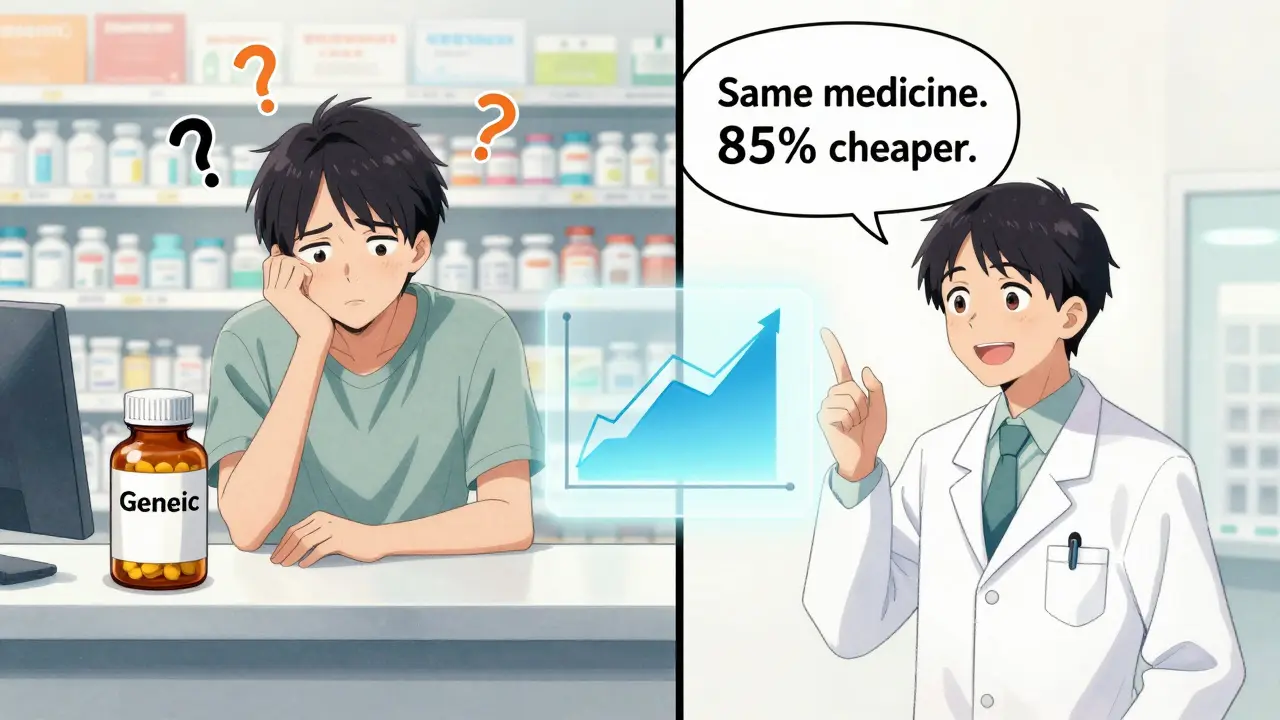
When Generics Aren’t the Right Choice
There are exceptions. For drugs with a narrow therapeutic index-like warfarin, levothyroxine, or some seizure meds-the margin between an effective dose and a harmful one is thin. That’s why some providers hesitate. But the American Academy of Family Physicians doesn’t say to avoid generics altogether. They say: don’t force it. Don’t switch without talking to the patient. And don’t assume a brand is always safer. The American College of Physicians says doctors should prescribe generics whenever possible. But they also say: use your judgment. If a patient has been stable on a brand for years, and switching causes confusion or anxiety, keep them on it. The goal isn’t to push generics for the sake of cost-it’s to ensure patients get the right treatment, affordably.How to Talk to Patients About Generics
Here’s what works:- Don’t wait for them to ask. Say it upfront: "I’m prescribing a generic version of this medication. It’s just as effective, but it costs a lot less."
- Explain the difference in appearance. "The pill might look different, but it’s the same medicine. The color or shape doesn’t change how it works."
- Use numbers. "This brand costs $120 a month. The generic is $18. That’s $1,200 a year you won’t have to pay."
- Reinforce trust. "The FDA holds generics to the same standard as brand-name drugs. They’re not cheaper because they’re worse-they’re cheaper because they don’t need to spend millions on marketing."
- Follow up. If they’re on a new generic, check in at the next visit. "How’s the new pill working for you? Any side effects? Any questions?"
Barriers Providers Face
Time is the biggest obstacle. Primary care visits average 13 to 16 minutes. Adding a 3-minute conversation about generics feels impossible. But here’s the truth: skipping that conversation costs more time later. Patients who don’t understand why their pill changed are more likely to stop taking it. They come back with uncontrolled diabetes, high blood pressure, or worsening depression. Then you’re playing catch-up. That’s far more time-consuming. Another barrier? Pharmacy switching. Patients might get one generic one month, then a different generic the next. The pill looks different again. They get confused. They think they’re being given something new. Pharmacists need to explain this too-but they can’t do it alone. Providers should warn patients: "You might get a different-looking pill from the pharmacy from time to time. That’s normal. It’s still the same medicine."
The Bigger Picture: Cost, Access, and Equity
Generics make up 90% of all prescriptions filled in the U.S.-but only 23% of total drug spending. That’s not a fluke. That’s the power of competition. When a brand loses its patent, multiple companies start making the same drug. Prices drop-often to 15% of the original cost within a year. But now there’s a new problem. Some generic drugs are getting more expensive. In 2023, the American Society of Health-System Pharmacists warned that certain essential generics-like insulin, antibiotics, or heart meds-are becoming hard to find or too costly. This isn’t the norm, but it’s a growing risk. That’s why advocacy isn’t just about pushing generics. It’s about pushing for fair pricing, transparent supply chains, and policies that prevent shortages.What’s Next?
Electronic health records are starting to show real-time price comparisons at the point of prescribing. Soon, a doctor might see: "This brand costs $110. The generic costs $12. Switching saves the patient $1,000 a year." That’s powerful. But technology alone won’t fix mistrust. Only human conversation will. The most effective tool a provider has isn’t an algorithm. It’s their voice. Patients trust their doctors. Studies show that when a provider endorses a generic, patients are far more likely to accept it-even if they had doubts before. That’s the multiplier effect. One conversation. One trusted voice. A lifetime of better health.It’s Not Just About Money
Advocating for generics isn’t about cutting costs for insurers or hospitals. It’s about making sure people get the medicine they need. It’s about dignity. It’s about not having to choose between rent and refills. It’s about the patient who takes their pill every day because they weren’t scared of the color change. Providers are the bridge between science and trust. You don’t need to be a pharmacist or a policy expert. You just need to care enough to explain. Because when you do, you’re not just prescribing a drug. You’re prescribing adherence. You’re prescribing health. And you’re prescribing hope.Are generic drugs really as effective as brand-name drugs?
Yes. The FDA requires generic drugs to have the same active ingredient, strength, dosage form, and route of administration as the brand-name version. They must also prove bioequivalence-meaning they deliver the same amount of medicine into the bloodstream at the same rate. Studies show no difference in clinical outcomes between generics and brands for the vast majority of medications.
Why do generic pills look different from brand-name pills?
Generic manufacturers use different inactive ingredients-like dyes, fillers, or coatings-to avoid infringing on the brand’s patent. These changes affect the pill’s color, shape, or size, but not how the medicine works. The FDA requires that these differences don’t impact safety or effectiveness.
Can switching to a generic cause side effects?
Rarely. Most patients experience no change. But some people may react to a new inactive ingredient-like a dye or preservative-especially if they have allergies or sensitivities. That’s why providers should ask about past reactions and monitor patients after switching. For drugs with a narrow therapeutic index, like thyroid meds or blood thinners, close monitoring is especially important.
Why do some doctors refuse to prescribe generics?
Some doctors avoid generics out of habit, lack of awareness, or concern about patient confusion-especially with narrow therapeutic index drugs. Others may be influenced by pharmaceutical marketing. But major medical organizations like the American College of Physicians now recommend prescribing generics whenever appropriate, because they’re equally effective and significantly cheaper.
How much money can patients save with generics?
On average, generics cost 80-85% less than brand-name drugs. For example, a brand-name blood pressure pill might cost $120 a month, while the generic costs $15. That’s over $1,000 saved per year. A 2019 study found 90% of generic copays were under $20, compared to only 39% of brand-name copays.
Are there cases where brand-name drugs are necessary?
Yes. For drugs with a narrow therapeutic index-like warfarin, levothyroxine, or certain epilepsy medications-small differences in absorption can matter. In these cases, switching between brands and generics should be done carefully, with patient input and monitoring. But even then, it’s not always necessary to stay on brand. Many patients do well on generics with proper oversight.
Why do some patients refuse generic medications?
Many patients believe generics are inferior due to misinformation, past experiences with poor-quality generics (rare in the U.S.), or confusion when the pill looks different. Some associate price with quality. Others have heard anecdotes from friends. Provider education and clear communication are the most effective ways to overcome this resistance.
What role do pharmacists play in generic medication advocacy?
Pharmacists are often the first to interact with patients after a prescription is filled. They can explain why a pill looks different, confirm the medication is safe and effective, and answer questions about cost. Studies show pharmacist counseling increases patient confidence in generics and improves adherence. Providers should work with pharmacists to ensure consistent messaging.



Generics aren't just cheaper-they're the backbone of accessible care. I've seen patients with diabetes skip doses because they couldn't afford the brand. Switch them to generic insulin? They show up at follow-ups with HbA1c levels dropping. It's not magic. It's basic pharmacology and human dignity.
How quaint. One assumes that the common populace possesses the cognitive capacity to comprehend the FDA’s bioequivalence protocols. Alas, the plebeian mind clings to chromatic illusions and pill morphology as proxies for efficacy. One wonders if the next frontier will be educating patients that the color of their metformin does not correlate with the celestial alignment of their pancreas.
My grandma switched from brand to generic lisinopril and never looked back. Said the pill looked weird but her blood pressure hasn’t spiked since. She doesn’t know what bioequivalence means but she knows her body. Sometimes the science is just the footnote. The real data is in the patient’s daily life.
Of course the brand names are more expensive. They’re not selling medicine. They’re selling the illusion that the pill has a personality. The color, the logo, the fancy packaging-it’s all marketing theater. Meanwhile, the generic in the same bottle? Same active ingredient. Same results. Just no celebrity endorsement.
Just told my cousin she could save $800 a year by switching to generic atorvastatin. She cried. Not from sadness-from relief. That’s the real ROI of generics. Not dollars to insurers. Dollars to human lives.
In India, we’ve been using generics for decades. My uncle took a generic antihypertensive for 12 years-same as the brand, same results. The only difference? He could afford to eat rice and dal every day. The FDA standards are solid. What’s not solid is the stigma. We need to stop treating patients like children who can’t handle the truth.
I work in a clinic where 70% of patients are on Medicaid. We started scripting the generic conversation: "This is the same medicine, just cheaper." Within six months, refill rates jumped 22%. It’s not complicated. It’s just consistent, calm, clear communication. And yes-it takes five minutes. But skipping it costs us hours later.
Let’s be real-most providers don’t even know what bioequivalence means. They just say "it’s generic" and move on. And patients? They hear "cheaper" and assume "worse." That’s not ignorance. That’s systemic failure. We need mandatory training. Not optional. Mandatory. Like CPR.
My dad’s from Nigeria. He used to buy generics from a pharmacy in Lagos. He thought they were all fake. Came to the U.S., got prescribed a generic, panicked. Took him six months to trust it. I showed him the FDA page. He said, "So it’s not magic. It’s math." And that was the moment he stopped worrying.
Why are we still defending generics? They’re a product of corporate greed and regulatory capture. Brand-name drugs are developed through years of research. Generics are free-riders. If you want quality, pay for it. This obsession with cost-cutting is eroding the integrity of medicine.
While I appreciate the empirical underpinnings of bioequivalence, one must interrogate the epistemological framework underpinning patient trust. The phenomenological experience of pill morphology-its chromatic variance, its geometric configuration-constitutes a hermeneutic of therapeutic legitimacy. To dismiss this as mere superstition is to conflate pharmacological rigor with epistemic arrogance. The patient’s perception, however irrational, is a clinical variable.
Just say it’s the same drug. Less money. Works the same. No fluff. Patients get it. Stop overcomplicating it.
Let’s be honest-most providers don’t care. They’re overworked, underpaid, and drowning in EHR pop-ups. They don’t have time to explain generics. And when they do, it’s a rushed footnote between insurance checks and refill requests. This isn’t a communication problem. It’s a system failure. We’re asking doctors to be counselors, pharmacists, educators, and billers all at once. And then we’re shocked when patients don’t trust the blue pill.
I’m from rural Nebraska. My neighbor’s wife was on brand-name levothyroxine for 10 years. Switched to generic after her insurance changed. Told her doctor she felt "off." He didn’t listen. She ended up in the ER. Now she’s back on brand. Was it the generic? Maybe. Or maybe the switch messed with her routine. Point is-context matters. Not every patient is a statistic. Some need stability. And that’s okay.