
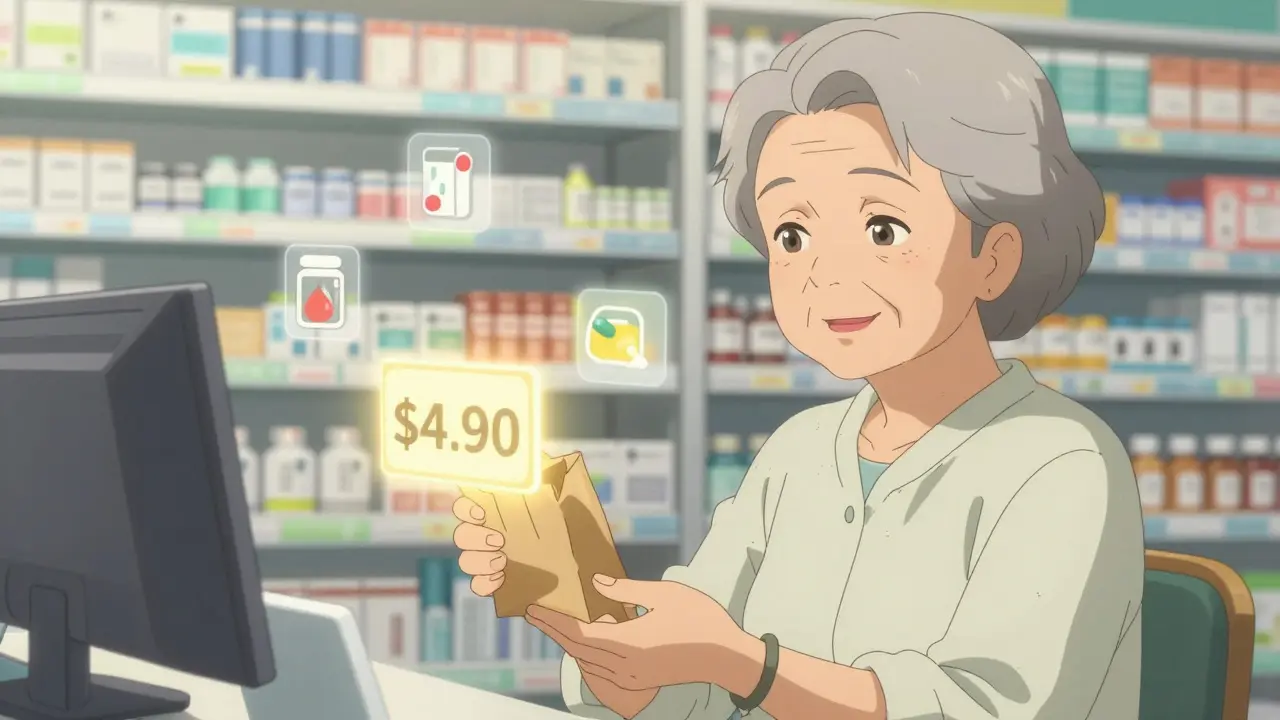
For millions of seniors on Medicare, paying for everyday medications like blood pressure pills, diabetes drugs, or cholesterol reducers can feel like a constant financial strain. But if you qualify for Medicare Extra Help, those costs drop dramatically - often to just $4.90 per generic prescription. This isn’t a discount or a coupon. It’s a federal program designed to remove the biggest barriers to taking your meds regularly.
Extra Help, officially called the Part D Low-Income Subsidy (LIS), isn’t optional. It’s a lifeline. In 2025, beneficiaries who qualify pay $0 for their Part D plan premium and deductible. That alone saves most people over $600 a year. But the real game-changer is what happens at the pharmacy counter. For generic drugs, you pay no more than $4.90 per fill. For brand-name drugs, it’s $12.15. Compare that to the standard Part D plan, where after paying a $595 deductible, you might pay 25% of the drug’s cost - meaning a $50 generic could cost you $12.50. Multiply that by 12 prescriptions a month, and you’re looking at nearly $750 in annual copays alone. With Extra Help? Just $70.80.
Eligibility is strict but clear. In 2025, an individual must have income below $23,475 a year and resources under $17,600. For a married couple living together, it’s $31,725 in income and $35,130 in resources. Income includes Social Security, pensions, and wages. Resources include bank accounts, stocks, bonds, and IRAs - but your home, one car, and personal belongings don’t count. There’s also a $1,500 allowance for burial expenses that doesn’t count against your limit. These numbers haven’t changed since 2024, but they’re still too low for many. Someone making $24,000 a year - still barely above minimum wage - gets cut off entirely. That’s the "cliff effect" experts warn about: a small bump in income can mean losing help for prescriptions that cost hundreds.
Here’s the kicker: you don’t have to apply every year. Once you’re in, you’ll get a review form in August. You have 30 days to return it. If you don’t, your benefits stop on January 1. That’s how many people lose coverage - not because they earned too much, but because they missed a deadline. The Social Security Administration sends these forms automatically, but if you moved, changed your name, or just didn’t open the mail, you’re at risk. State Health Insurance Assistance Programs (SHIPs) offer free help filling out these forms. You can find yours by calling 1-800-MEDICARE or visiting Medicare.gov.
Some people get Extra Help automatically. If you already get Medicaid, Supplemental Security Income (SSI), or a Medicare Savings Program, you’re enrolled without doing anything. That’s about 40% of Extra Help recipients. For everyone else, you can apply online at SSA.gov, by phone at 1-800-772-1213, or in person at your local Social Security office. The process takes 3 to 6 weeks. Don’t wait until you’re out of meds to start. Apply early. Even if you think you make too much, fill out the form. The SSA looks at your full financial picture - not just your pay stub.
Extra Help doesn’t just cut costs - it changes behavior. Studies show people who get this subsidy are 23 percentage points more likely to take their meds as prescribed. That means fewer hospital trips, fewer ER visits, and better health overall. One pharmacist on Reddit shared how a patient with high blood pressure was skipping doses because each refill cost $30. After Extra Help, the copay dropped to $4.90. Within three months, their blood pressure normalized. That’s the real impact.
But there are limits. Extra Help doesn’t cover every drug. Each Part D plan has its own formulary - a list of approved medications. You still need to check if your specific generic is covered. If it’s not, you can request a formulary exception. Extra Help beneficiaries have an easier time getting these approved. You can also switch Part D plans once a month, which gives you flexibility to find the best coverage for your meds. That’s a big advantage over regular enrollees, who can only change once a year.
What about insulin? Starting in 2025, all Medicare Part D beneficiaries pay no more than $35 a month for insulin - no matter if they have Extra Help or not. That’s a separate rule, but it works alongside Extra Help. If you’re on insulin, you’re now protected twice: once by the $35 cap, and again by your $4.90 generic copay if your insulin is generic. That’s a huge win.
Still, many eligible people don’t enroll. The Center for Medicare Advocacy found that 37% of those who qualify never apply. Why? The forms are confusing. The income rules feel arbitrary. And many believe they don’t qualify because they own a car or have a small savings account. They’re wrong. You can have up to $17,600 in savings and still qualify. That’s more than most people think.
There’s no other program like this in Medicare. No supplemental insurance, no discount card, no coupon can match what Extra Help does. It removes premiums, deductibles, and caps copays. It’s not perfect - the income limits are outdated, and the paperwork is a hurdle. But for those who get it, it’s the difference between managing a chronic illness and ignoring it because you can’t afford the pills.
If you or someone you know is on Medicare and takes one or more generic drugs every month, it’s worth checking eligibility. Even if you think you make too much, fill out the application. The worst that happens is you get a "no" - but the best? You save hundreds - maybe over a thousand - on prescriptions every year.


This is why America's welfare system is broken. People get handed free stuff like it's a right, not a privilege. You think someone making $24,000 'can't afford' meds? Maybe they shouldn't have moved to a $3k rent apartment and bought a new truck last year. Stop rewarding poor choices.
This is amazing! In India, we struggle to get even basic meds without paying half our salary. I'm so glad someone's finally getting real help. Keep pushing for more people to apply - you deserve to live healthy, not just survive!
i had no idea about the 30-day form thing!! i just lost my extra help last year because i moved and never got the mail. my pharmacist said i was 'lucky' i didn't end up in the hospital. oops. sorry for the typos, typing on my phone while my cat sits on my lap 🐱
I’ve seen this firsthand. My mom was skipping her statins because of the $15 copay. Once she got Extra Help? Her numbers went from scary to normal in 2 months. It’s not charity - it’s basic healthcare.
wait so if i have $17k in savings i still qualify? i thought it was like $5k max. lol i might apply. i’m on 3 generics and i’m tired of choosing between meds and groceries.
This whole program is a trap. The government knows people won’t read the fine print. They set the deadline in August so you’re distracted by back-to-school stuff. Then in January, they cut you off and say 'you didn’t respond.' It’s not incompetence - it’s intentional. They want you to get sick so they can push you into Medicaid. Watch what happens next: they’ll start charging for the 'review form.' Mark my words.
Just applied yesterday. Took 20 minutes online. Got approved in 3 days. If you’re on the fence, do it. It’s not a handout - it’s your money, honestly.
The structural implications of this policy are profound. By eliminating financial barriers to essential pharmacotherapy, the program demonstrably reduces downstream healthcare expenditures. The 23-percentage-point increase in medication adherence aligns with behavioral economics models of cost sensitivity. Furthermore, the automatic enrollment for SSI recipients represents a significant efficiency gain in social service delivery. One must acknowledge, however, that the income thresholds remain stagnant despite inflationary pressures, thereby creating de facto exclusion zones for working-class seniors. This is not a failure of intent, but rather a failure of legislative recalibration.
I can’t believe how many people don’t know about this! I helped my neighbor fill out the form last week - she was crying because she thought she made too much. She didn’t even know her car didn’t count! Please, if you’re reading this - call 1-800-MEDICARE. Seriously. It’s free help.
You think this is generosity? This is how they pacify the masses. In Nigeria, we don’t get 'lifelines' - we get real solutions. People here are so dependent on government handouts they forget how to budget. My cousin in Lagos pays $0.20 per pill because she buys in bulk from India. Why are we still talking about $4.90? This isn’t progress - it’s a Band-Aid on a severed artery.
The real issue isn't the copay - it's that we've turned medicine into a transaction. You're not 'saving money' - you're being allowed to live because the system decided you're worth it. What kind of society makes you beg for the right to take your blood pressure pills? We've normalized suffering. And now we pat ourselves on the back for giving you $4.90 instead of $12.50. That's not compassion. That's just less cruelty.
I’m on lis too. It’s been life-changing. I used to ration my metformin. Now I take it like clockwork. No drama. No guilt. Just health. If you’re eligible - just do it. No one’s judging.
I don’t get why people are so excited. I mean, it’s just $4.90. What’s the big deal? I pay $10 for coffee. This isn’t saving lives - it’s saving a latte. And honestly, if you can’t afford your meds, maybe you shouldn’t be on them? Just a thought.