

For years, taking a daily low-dose aspirin was a common habit for millions of people trying to avoid a first heart attack or stroke. But the advice has changed - and not just a little. Today, aspirin for primary prevention is no longer a one-size-fits-all solution. In fact, for many adults, especially those over 60, it may do more harm than good.
Why the Rules Changed
Back in the 1990s, studies like the Physicians’ Health Study showed that aspirin could lower the risk of a first heart attack. That led to widespread recommendations: if you were over 50, especially with high blood pressure or high cholesterol, take a baby aspirin every day. It seemed simple. Cheap. Safe. But over time, researchers noticed something troubling. While aspirin did reduce heart attacks slightly, it also increased serious bleeding - in the stomach, intestines, and even the brain. The bigger the age, the worse the risk. A 70-year-old doesn’t just have a higher chance of a heart attack - they also have a much higher chance of bleeding badly from aspirin. And when the numbers are weighed, the harm often outweighs the benefit. In 2022, the U.S. Preventive Services Task Force (USPSTF) flipped its stance completely. They now say: do not start daily aspirin if you’re 60 or older. For people between 40 and 59, it’s not a clear yes or no. It depends on your personal risk - and your bleeding risk. If you’re in that middle group, talk to your doctor. Don’t just keep taking it because you always have.Who Definitely Should Skip Aspirin
There are clear groups of people who should avoid daily aspirin entirely - even if they’re under 60.- Anyone with a history of stomach ulcers - About 4% of U.S. adults have had one. Aspirin irritates the stomach lining. For these people, even low doses can trigger bleeding.
- People taking blood thinners - If you’re on warfarin, apixaban, rivaroxaban, or similar drugs, adding aspirin doubles your bleeding risk. No exceptions.
- Those on regular NSAIDs - Ibuprofen, naproxen, even occasional use of Advil or Aleve, increases the chance of gastrointestinal bleeding when mixed with aspirin. This affects nearly 1 in 5 adults over 65.
- People with uncontrolled high blood pressure - High BP already strains blood vessels. Aspirin can make brain bleeds more likely.
- Anyone with a bleeding disorder - Conditions like hemophilia or von Willebrand disease make aspirin dangerous.
The Gray Zone: Ages 40-59
This is where things get messy. For people in their 40s and 50s, the decision isn’t automatic. It’s personal. The USPSTF says consider aspirin only if you have at least a 10% chance of having a heart attack or stroke in the next 10 years. That number comes from a tool called the Pooled Cohort Equations. It factors in age, sex, race, cholesterol, blood pressure, diabetes, and smoking status. But here’s the catch: even if your 10-year risk hits 10%, you still need to check your bleeding risk. Use the HAS-BLED score - it looks at things like kidney disease, liver disease, alcohol use, and past bleeding episodes. If you score 3 or higher, skip aspirin. The risk of bleeding is too high. One study found that for every 1,000 people aged 40-59 with high CVD risk who took aspirin daily for 10 years, about 20 heart attacks were prevented. But 17 major bleeds happened. That’s almost a wash. And for some, the bleed was life-changing - or fatal.
What About Diabetes?
Diabetes is a major risk factor for heart disease. Many assume people with diabetes should automatically take aspirin. Not anymore. The 2025 AHA/ACC guidelines say: only consider aspirin for adults with diabetes aged 40-70 if their 10-year CVD risk is 15% or higher - and only if they have no bleeding risk. That’s a much narrower group than before. A 2024 study in Diabetes Care found aspirin helped only those with high levels of Lp(a) - a genetic cholesterol marker. For others with diabetes, there was no benefit. So if you have diabetes, don’t assume aspirin is right for you. Get tested. Talk to your doctor.Why People Keep Taking It Anyway
Despite the guidelines, many people still take aspirin daily. A 2023 Mayo Clinic survey found 41% of adults over 60 continued taking it - even after their doctors told them to stop. Why? Fear. Many say, “I’ve been taking it for 20 years. What if I have a heart attack tomorrow?” But the truth is, if you’re over 60 and never had a heart attack or stroke, aspirin isn’t giving you much protection anymore. The benefit is tiny. The risk? Real. Another reason? Confusion. Patients often mix up primary and secondary prevention. Primary prevention means preventing a first event. Secondary means preventing a second event after you’ve already had one. If you’ve had a heart attack, stent, or stroke - then aspirin is still strongly recommended. But if you haven’t? The rules are totally different. A 2023 JAMA Internal Medicine study found 57% of patients got conflicting advice from their doctors. One doctor said stop. Another said keep going. That’s not a failure of the patient - it’s a failure of the system. Guidelines changed fast. Not every doctor kept up.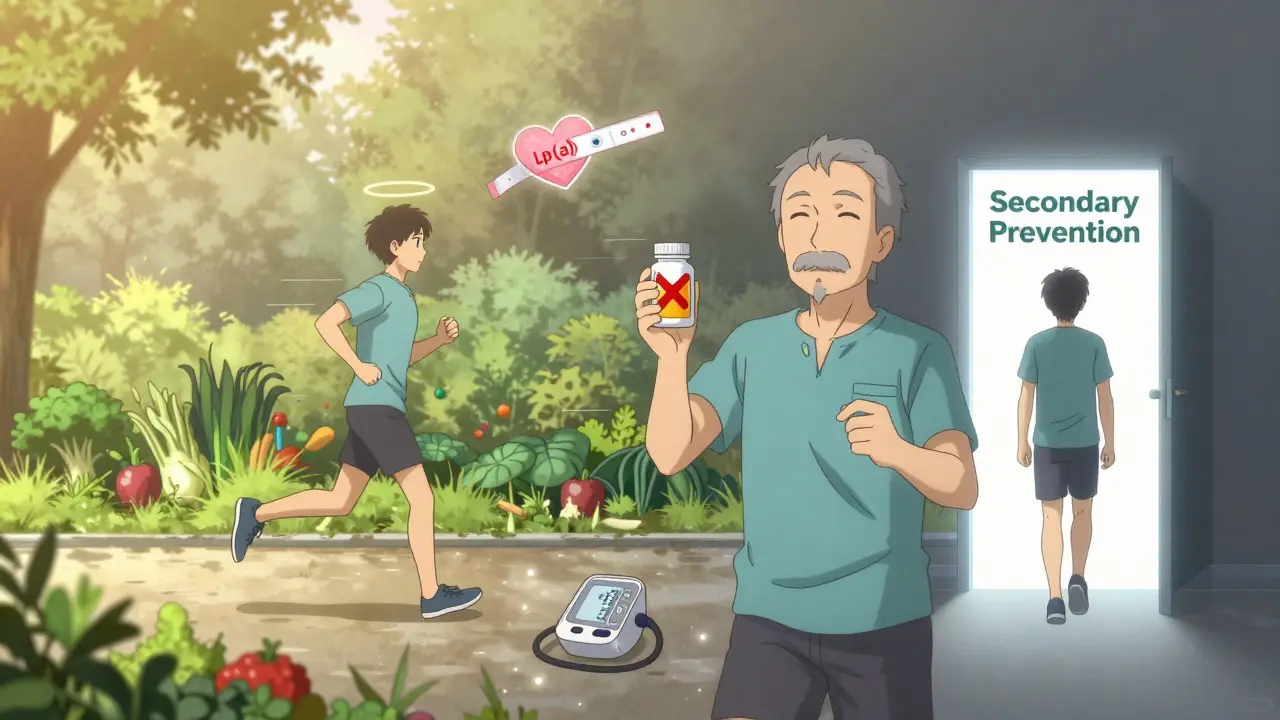
What to Do Instead
If you’re not taking aspirin for primary prevention, what should you do?- Focus on lifestyle - Quit smoking. Move more. Eat more vegetables and less processed food. Control your blood pressure. These do more than aspirin ever could.
- Check your numbers - Get your LDL cholesterol, blood sugar, and blood pressure checked annually. Know your numbers.
- Ask about CAC scoring - Coronary Artery Calcium (CAC) scans show actual plaque buildup in your heart arteries. If your score is over 100, your risk is high - even if your cholesterol looks okay. Some cardiologists still recommend aspirin for these patients, but it’s controversial.
- Use free tools - The American Heart Association’s “Know Your Risk” calculator is free and easy to use. So is the USPSTF’s decision aid.
The Bottom Line
Aspirin isn’t magic. It’s a drug with side effects. For most people without heart disease, it’s no longer a preventive tool - it’s a risk. If you’re over 60 - don’t start. If you’re already taking it, talk to your doctor about stopping. Don’t quit cold turkey - taper slowly under supervision. If you’re 40-59 and healthy - don’t assume you need it. Calculate your risk. Check your bleeding risk. Make a shared decision with your doctor. And if you’ve had a heart attack, stroke, or stent - keep taking it. That’s not primary prevention. That’s life-saving. The days of automatic aspirin are over. The new standard is: no aspirin unless the math clearly says yes.Should I stop taking aspirin if I’m over 60?
Yes, if you’ve never had a heart attack, stroke, or stent. The U.S. Preventive Services Task Force recommends against starting aspirin after age 60 because the risk of bleeding - especially in the stomach or brain - outweighs the small benefit in preventing a first heart event. If you’re already taking it, don’t stop suddenly. Talk to your doctor about a safe plan to taper off.
Is aspirin still okay if I have diabetes?
Maybe - but only if you’re between 40 and 70, have a 10-year cardiovascular risk of 15% or higher, and have no bleeding risks. A 2025 guideline update says aspirin isn’t routinely recommended for all people with diabetes. In fact, it only helps those with specific risk markers like high Lp(a) or a coronary calcium score over 100. Most people with diabetes won’t benefit.
Can I take aspirin if I also take ibuprofen?
No. Taking aspirin with ibuprofen, naproxen, or other NSAIDs greatly increases your risk of stomach bleeding. Even occasional use of Advil or Aleve can interfere. If you need pain relief while on aspirin, talk to your doctor about acetaminophen (Tylenol) instead - it doesn’t affect bleeding risk the same way.
What’s the difference between primary and secondary prevention?
Primary prevention means trying to prevent a first heart attack or stroke in someone who’s never had one. Secondary prevention is for people who already had one - and are taking aspirin to prevent another. Aspirin is still strongly recommended for secondary prevention. But for primary prevention, the risks now often outweigh the benefits - especially after age 60.
How do I know my 10-year heart disease risk?
Your doctor can calculate it using the Pooled Cohort Equations, which use your age, sex, race, cholesterol, blood pressure, diabetes status, and smoking history. You can also use the American Heart Association’s free online calculator. A score of 10% or higher means you might benefit from aspirin - but only if your bleeding risk is low.
Is there a test to see if aspirin will work for me?
Not yet in routine practice - but research is moving in that direction. Some labs now offer genetic tests to see how your body responds to aspirin. One study found people with certain gene variants don’t get the same heart protection from aspirin. Experts predict these tests will become standard in the next five years. For now, focus on your overall risk profile instead.
What if my doctor still recommends aspirin?
Ask why. Some doctors, especially cardiologists, still recommend it for patients with high coronary calcium scores or strong family histories. But they’re going against the latest guidelines. Get a second opinion. Ask for your CAC score, Lp(a) level, and bleeding risk score. If your doctor can’t provide those numbers, you might be taking aspirin without a clear reason.
Can I take aspirin if I’m on blood pressure meds?
It depends. If your blood pressure is well-controlled (below 140/90), aspirin may still be an option - if you’re under 60 and have high heart disease risk. But if your blood pressure is high or uncontrolled, aspirin increases your risk of brain bleeding. Talk to your doctor before combining them.
Aspirin isn’t going away. But its role has changed. It’s no longer a daily shield for healthy people. It’s a targeted tool - and only for very specific cases. Don’t rely on habit. Rely on data.


It is imperative to recognize that the paradigm shift regarding aspirin usage is not merely a clinical adjustment but a systemic recalibration of preventive medicine. The data is unequivocal: for individuals over sixty, the hemorrhagic risk surpasses any marginal cardiovascular benefit. The USPSTF guidelines are not suggestions-they are evidence-based mandates. To continue aspirin therapy without rigorous risk stratification is not just negligent-it is reckless. The burden of proof lies with the patient, not the physician.
Furthermore, the notion that 'I've been taking it for 20 years' is an emotional fallacy masquerading as medical logic. Habit does not equate to efficacy. The body changes. Risk profiles evolve. Ignoring this is tantamount to refusing to update software on a vulnerable system.
It is also worth noting that the persistence of this practice among elderly populations reflects a broader failure in health literacy. Patients are not being educated-they are being conditioned. This is not autonomy. This is indoctrination by inertia.
Primary prevention was never intended to be a blanket prescription. It was meant to be a targeted intervention. The conflation of primary and secondary prevention is the root of this epidemic of inappropriate use. We must stop treating patients like they are data points and start treating them like individuals with unique biological signatures.
And yet, we continue to default to the easiest path. Aspirin is cheap. Aspirin is familiar. Aspirin is comforting. But comfort is not clinical justification. The science has spoken. Now we must have the courage to listen.
Let us not mistake the absence of a heart attack for the presence of protection. The absence of bleeding is not proof of efficacy. It is merely luck.
Doctors who still prescribe aspirin to asymptomatic patients over 60 are not practicing medicine. They are practicing nostalgia.
The future of preventive care is not in pills. It is in personalized risk assessment. It is in lipidomics. It is in genetic profiling. It is in coronary calcium scoring. Not in aspirin.
Every patient who takes aspirin without a documented 10-year CVD risk above 10% and a HAS-BLED score below 3 is a statistical liability waiting to hemorrhage.
The era of 'just in case' medicine is over. Welcome to the era of 'only if the math says yes.' And the math, for most, says no.
Stop the aspirin. Start the conversation. And if your doctor resists? Demand a second opinion. Or better yet-demand a risk calculator.
And if you are still reading this and thinking 'but my grandfather took it and lived to 90'? Your grandfather was an outlier. You are not.
Do not be the next statistic. Be the one who changed the habit.
lol the USPSTF is just a woke committee that hates aspirin because it's too cheap and doesn't have a patent. they're scared of Big Pharma losing money so they're pushing this 'don't take aspirin' narrative to make you buy $500/month supplements instead. also, i've been taking 81mg daily for 15 years and my c-reactive protein is below 0.5. the study they cite? funded by pharma. the bleeding risk? overstated. they're just trying to sell you a new drug. #aspirinlivesmatter
You people are delusional. You think a few studies changed everything? Aspirin has been saving lives since 1897. This whole 'risk-benefit' nonsense is just another way for doctors to feel superior while charging you $300 for a 'risk assessment.' You're not protecting yourself-you're surrendering to a system that wants you dependent on expensive tests and pharmaceuticals. The fact that 41% of seniors still take it? That's wisdom. That's intuition. That's what happens when people stop trusting the latest fad. Aspirin isn't magic. But neither is a $1200 ultrasound. I'll take the cheap red pill any day.
so i just stopped taking it last week because my doc said to. felt weird. like i was forgetting to brush my teeth. now i'm just waiting for my heart to give out. lol. also, my brother says aspirin makes his headaches go away. so he's still taking it. guess we'll see who's right.
The persistence of this outdated practice among older adults is not merely a clinical oversight-it is a profound failure of medical communication. The conflation of primary and secondary prevention is not a misunderstanding; it is a systemic collapse in patient education. The USPSTF guidelines are not ambiguous-they are precise. The failure lies not in the science, but in the inability of healthcare providers to articulate risk with clarity. When patients are left to interpret statistical probabilities through the lens of anecdote and fear, the result is not autonomy-it is vulnerability. We must stop treating patients like they are incapable of understanding numbers. We must stop assuming that 'I've always taken it' is a valid medical rationale. This is not about aspirin. This is about whether medicine still believes in evidence-or merely in tradition.
Here's the real issue no one talks about: if you're over 60 and never had a heart attack, you're probably not going to get one anyway. Aspirin doesn't prevent aging. It just adds bleeding risk. Meanwhile, the real drivers of heart disease-processed food, sitting all day, chronic stress-are being ignored because they're not profitable. We're obsessed with pills and not lifestyle. That's why this whole debate is a distraction. Stop focusing on aspirin. Start focusing on why people in their 60s are eating donuts for breakfast and watching Netflix for 12 hours a day. That's the real epidemic. Aspirin is just the symptom.
Oh wow. So now we're supposed to trust 'guidelines' from a task force that changed its mind in 2022? And we're supposed to believe that a 10-year risk calculator is somehow more reliable than decades of clinical observation? Funny how the same people who scream 'trust the science' when it suits them suddenly ignore the fact that science changes. And yet, here we are-discarding a $0.02 pill because a group of statisticians ran a model that didn't account for human behavior. The real tragedy? People are going to die not because they took aspirin-but because they stopped trusting their own instincts because some algorithm told them to.
aspirin is a myth. i dont even know why we thought it worked. my uncle took it for 30 years and still had a stroke. so much for prevention. now i just eat more veggies. and drink water. and sleep. like a caveman. no pills. no stress. no doctors. just chill. maybe thats the real medicine.
OMG I JUST STOPPED ASPIRIN LAST WEEK AND I'M CRYING BECAUSE I'M SO SCARED I'M GONNA DIE TOMORROW 😭 I MEAN I'VE BEEN TAKING IT SINCE I WAS 45 AND NOW I FEEL LIKE I'M WALKING A TIGHTROPE WITHOUT A NET AND WHAT IF I HAVE A HEART ATTACK AND MY KIDS WILL NEVER FORGIVE ME AND MY DOCTOR DIDN'T EXPLAIN IT WELL AND NOW I'M ON A SUPPORT FORUM FOR PEOPLE WHO QUIT ASPIRIN AND I JUST WANT TO GO BACK TO BEING SAFE 😭😭😭
aspirin is bad. bleeding is bad. stop it. done.
I really appreciate this breakdown. I’ve been taking aspirin since my 50s because my dad did, but after reading this, I ran my numbers through the AHA calculator and my 10-year risk is only 6%. My HAS-BLED score is 2, so I’m going to talk to my doctor about tapering off. It’s scary to let go of something you’ve done for so long-but this makes sense. Thanks for the clarity.
aspirin is a trap. i took it for 10 years and ended up in the er with a gastric bleed. now i'm on a diet, walking 6 miles a day, and my blood pressure is perfect. no pills. no fear. just life. if you're still taking it, you're not being smart-you're being lazy.
Guidelines changed. Patients didn't. That's the problem. Not the science. The silence. The lack of follow-up. The assumption that 'I'll just keep doing what I've always done.' That's not compliance. That's negligence. Stop prescribing. Start explaining.
Aspirin for primary prevention? That's a liberal policy. Real Americans don't need a government task force to tell them what to swallow. We've been taking aspirin since the Reagan era. If you're worried about bleeding, eat more fiber. Move more. Don't let bureaucrats decide your health. This is America. Not a clinical trial.