

Chronic watery diarrhea that won’t go away? If you’ve been told you have IBS-D but nothing seems to help, you might be dealing with something else entirely: bile acid diarrhea. It’s not rare-about 1 in 4 people diagnosed with IBS-D actually have it. And the good news? It’s treatable. Unlike IBS, which often requires long-term symptom management, bile acid diarrhea can improve dramatically with the right diagnosis and simple interventions.
What Exactly Is Bile Acid Diarrhea?
Your liver makes bile to help digest fats. Normally, 95% of bile acids are reabsorbed in the last part of your small intestine, the terminal ileum, and recycled back to the liver. In bile acid diarrhea (BAD), that system breaks down. Too much bile ends up in your colon, where it acts like a laxative. It pulls water into the bowel, speeds up movement, and leaves you with frequent, urgent, watery stools-sometimes even at night. There are three types:- Type I: Caused by damage or removal of the ileum-think Crohn’s disease, surgery, or radiation.
- Type II: No obvious cause. This is the most common and often mistaken for IBS-D.
- Type III: Triggered by other conditions like gallbladder removal, celiac disease, or chronic pancreatitis.
It’s not just discomfort. People with BAD often report greasy, pale stools that are hard to flush, nighttime bathroom trips, and even accidental leaks. Studies show that 52% of patients have nocturnal diarrhea at least three times a week. That’s not normal-and it’s not just "stress."
How Is It Diagnosed?
Most doctors don’t test for BAD unless you push for it. That’s why the average delay in diagnosis is six years. But the tools are there.- SeHCAT test: The gold standard outside the U.S. You swallow a radioactive tracer that mimics bile acid. A scan after 7 days measures how much your body kept. If retention is below 15%, you have BAD. Problem? It’s not available in 90% of U.S. hospitals.
- Serum C4 test: A simple blood test. C4 is a chemical your liver makes when producing bile. Levels above 15.3 ng/mL strongly suggest BAD. Accuracy is around 77-82%, making it a practical first step.
- FGF-19 blood test: This hormone tells your liver to slow bile production. If your FGF-19 is below 85 pg/mL, your body isn’t regulating bile properly. It’s a newer test, but gaining traction.
- Fecal bile acid test: Measures bile acids directly in stool. Highly accurate but requires a 48-hour collection and specialized labs.
Many gastroenterologists now recommend testing for BAD in anyone with chronic diarrhea lasting more than 4 weeks-especially if they’ve been diagnosed with IBS-D. If you’ve tried low-FODMAP diets and still have symptoms, ask your doctor about C4 or FGF-19 testing. It’s faster, cheaper, and less invasive than a colonoscopy.
Bile Acid Binders: The First-Line Treatment
These medications work like sponges in your gut. They grab excess bile acids before they reach your colon and flush them out harmlessly in stool. Three are commonly used:| Medication | Dose | Form | Side Effects | Adherence Rate |
|---|---|---|---|---|
| Cholestyramine (Questran) | 4g, 1-2 times daily (max 16g/day) | Powder (chalky texture) | Constipation (20-30%), bloating, nausea | Low-40% quit within 6 months |
| Colestipol (Colestid) | 5g, 1-2 times daily | Powder or tablets | Mild constipation, bloating | Medium-60% continue long-term |
| Colesevelam (Welchol) | 1.875-3.75g daily, 1-2 doses | Tablets | Constipation in only 5%, less bloating | High-75% stay on it |
Studies show about 70% of people with confirmed BAD see improvement within 2-3 days of starting a binder. But sticking with it is the hard part. Cholestyramine tastes like wet chalk. Mixing it with apple juice or smoothies helps. Colesevelam is easier to swallow and doesn’t need mixing-it’s why it’s now the most prescribed binder in the U.S.
Side effects like constipation are common. Don’t stop cold turkey. Lower the dose slightly, increase soluble fiber, and drink more water. Most people find a balance.

Dietary Strategies That Actually Work
Medication alone isn’t always enough. Diet plays a huge role.- Reduce fat intake to 20-40g per day. Fat triggers bile release. Cutting fat below 30g daily can reduce bowel movements by 40%. Avoid fried food, fatty meats, butter, cream, and full-fat dairy. Read labels-hidden fats are everywhere.
- Take soluble fiber daily. Psyllium husk (5-10g per day) binds bile acids just like the medication. One study showed a 35% drop in daily bowel movements. Take it with water before meals.
- Eat smaller, more frequent meals. Three big meals = one big bile dump. Six small meals = steady, manageable bile release. A Cleveland Clinic study found this cut post-meal urgency by 25%.
- Avoid triggers. Caffeine increases colon movement by 15-20%. Artificial sweeteners like sorbitol pull water into the gut. Alcohol and spicy foods can worsen symptoms. Keep a food diary for 2-4 weeks to find your personal triggers.
- Try the Specific Carbohydrate Diet (SCD). Eliminating complex carbs (grains, sugar, lactose) helped 45% of patients in one survey. It’s not for everyone, but worth exploring if other diets fail.
Many patients report the best results when they combine binders with diet. One Reddit user described: "I take 1.875g of Welchol twice a day and 5g psyllium before every meal. My stools are normal now. No more panic attacks before leaving the house."
What About the Future?
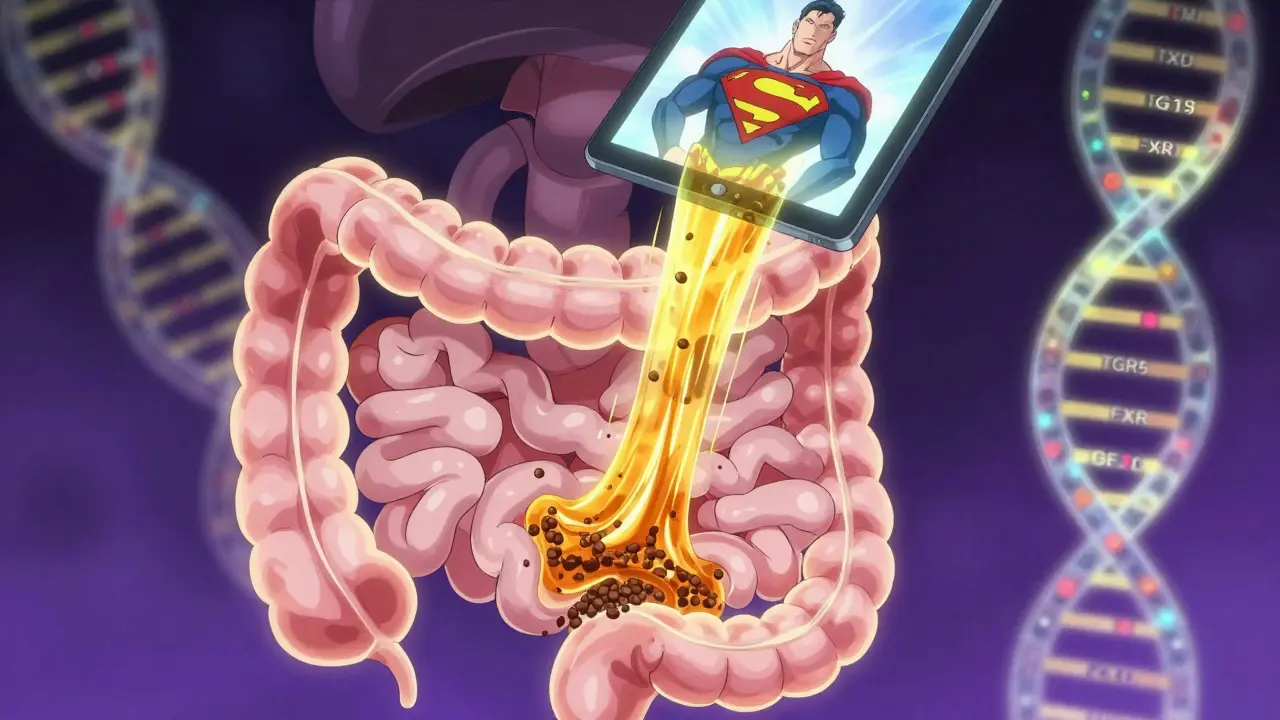
New treatments are on the horizon. Researchers are testing FGF-19 analogs-drugs that mimic the body’s natural bile regulator. Phase 3 trials showed 72% symptom improvement in patients who didn’t respond to binders. These could be game-changers by 2026.Genetic testing is also advancing. Scientists have identified four genes linked to BAD susceptibility (TGR5, ASBT, FXR, FGF19). In the next few years, a simple DNA test might predict who’s at risk before symptoms start.
Apps like BAD-Score use AI to predict flare-ups based on your diet, sleep, and stress levels. They’re not perfect-but they’re helping people take control.
When to See a Specialist
If you’ve had diarrhea for more than 4 weeks and:- IBS treatments didn’t help
- You’ve had gallbladder surgery
- You have Crohn’s or have had ileum surgery
- Your stools are pale, greasy, or float
Ask your doctor for a C4 test or referral to a gastroenterologist who knows about BAD. Most primary care providers still think it’s rare. But it’s not. And treating it early can change your life.
Real-Life Tips from People Living with BAD
- "I mix my cholestyramine with cold apple juice and a splash of vanilla extract. It’s bearable now."
- "I switched to grilled chicken, steamed veggies, and oatmeal. No more panic before meetings."
- "I started taking psyllium at night. It’s like a gentle brake on my colon."
- "I keep a small bag of soluble fiber packets in my purse. Emergency diarrhea? I’m covered."
There’s no cure yet, but with the right combo of binders, diet, and awareness, most people regain control. You don’t have to live with constant urgency. It’s not in your head. It’s bile-and it can be managed.
Can bile acid diarrhea be cured?
There’s no permanent cure, but most people achieve full symptom control with bile acid binders and dietary changes. Type I BAD may improve if the underlying cause (like Crohn’s) is treated. Type II often requires lifelong management, but many live symptom-free with the right plan.
Is bile acid diarrhea the same as IBS-D?
No. IBS-D is a functional disorder with no clear physical cause. Bile acid diarrhea is a biochemical problem-too much bile in the colon. About 25-30% of people diagnosed with IBS-D actually have BAD. Treating it like IBS won’t work. Testing for BAD can save years of trial and error.
Can I take bile acid binders long-term?
Yes. Colesevelam is approved for long-term use and is safe for years. It doesn’t affect nutrient absorption like older binders. Some people reduce their dose after symptoms improve, but many stay on a low maintenance dose indefinitely. Always check with your doctor.
Do bile acid binders cause weight loss?
Not directly. But many people lose weight because they stop eating fatty foods to avoid symptoms. If you’re unintentionally losing weight or feeling weak, talk to your doctor-it could signal malabsorption or another issue.
Can I use natural remedies instead of binders?
Soluble fiber like psyllium is a natural binder and works well for mild cases. But if your bile acid levels are high, fiber alone won’t be enough. Don’t skip medical testing. Binders are proven and effective. Natural remedies can help-but not replace-treatment.
What if binders don’t work for me?
Try switching binders-some people tolerate one better than another. If that fails, ask about FGF-19 analogs, which are in late-stage trials. Also, recheck your diet. Sometimes, hidden fats or artificial sweeteners are still triggering symptoms. A registered dietitian specializing in gut health can help fine-tune your plan.


OMG I’ve been dealing with this for YEARS and no one ever told me it could be bile acid diarrhea 😭 I thought I was just "stressy". Switched to Welchol + psyllium and now I can actually leave the house without a panic attack. Thank you for this post!
The biochemical elegance of bile acid homeostasis is truly underappreciated in mainstream gastroenterology. One is compelled to reflect upon the ontological dissonance between symptomatic management and mechanistic intervention-this condition, though clinically common, remains epistemologically marginalized.
I’ve been prescribing colesevelam for BAD for years now. The adherence rates are way better than cholestyramine-especially for older patients. And psyllium? It’s basically nature’s Welchol. I always tell my patients to start there before jumping to meds.
I’m curious-how many of these patients were on long-term PPIs? I’ve seen a lot of bile acid issues emerge after acid suppression therapy disrupts the duodenal feedback loop. Could be a confounder.
IBS is just a catch all for doctors who dont wanna do real work and now theyre just slapping on another label to sell more pills lol
I’ve been this person. The panic. The midnight runs. The shame. I cried when I finally got a diagnosis. This post? It’s the only thing that made me feel seen.
This is a well-structured overview. Thank you for the clinical clarity.
Wait so psyllium is like a natural binder?? I thought it was just for constipation?? I’ve been taking it wrong??
This is why America is falling apart. We let unlicensed bloggers give medical advice. The FDA should shut this down. I’ve read the real journals-this is all anecdotal nonsense.
You’re all missing the point. This isn’t about bile. It’s about the gut-brain axis being hijacked by corporate pharma to sell binders. The real cure is fasting and grounding. I’ve been doing it for 3 years. No meds. No problems.
Man I was diagnosed with IBS-D for 5 years before someone finally ran a C4 test. Turned out I had Type II BAD. Welchol + cutting out fried chicken = life changed. No more hiding in bathroom stalls at work.
This is all a cover-up for 5G radiation damaging your ileum. I’ve got the documents. The CDC knows. They’re just waiting for the right time to admit it. Also, psyllium is made from GMO flax. Don’t trust it.
In Nigeria we call this 'omo gut'-but no one knows the science. I’ve seen patients on cholestyramine and they look like zombies. But when they cut palm oil? Magic. This post is gold.
I’m from Texas. We don’t do bile acids here. We do brisket, fried okra, and whiskey. But my cousin’s wife tried this and now she eats salads without crying. I’m impressed.
Let me tell you something. I spent 11 years in the ER. I’ve seen people with diarrhea so bad they were leaking on the gurney. I’ve seen people cry because they couldn’t hold it during their kid’s graduation. And then I saw a woman on Welchol and psyllium-she walked out of the ER like she’d been reborn. This isn’t just medicine. It’s dignity. And this post? It’s a manifesto for the silent millions who’ve been told it’s all in their head. Don’t let them gaslight you. Demand the C4 test. Your colon will thank you.