
When your child is sick, you don’t want to guess what medicine to give them. You need to know exactly how much, what form, and when. Giving a child an adult pill, even crushed, can be dangerous. Kids aren’t just small adults-their bodies process medicine differently. Their livers, kidneys, and brains are still developing, and that changes how drugs work. What’s safe for a 12-year-old could be life-threatening for a 2-year-old. That’s why age-appropriate medications matter more than ever.
Why Kids Need Different Medicines
For decades, doctors treated children like mini-adults. They’d take an adult dose and cut it in half. But that approach caused serious harm. In the 1970s, aspirin was commonly given to kids with fevers-until researchers linked it to Reye’s syndrome, a rare but deadly condition that swells the brain and liver. Since then, we’ve learned that children metabolize drugs faster or slower depending on their age, weight, and organ maturity.
Neonates (babies under 28 days) have underdeveloped livers and kidneys. A drug that’s safe for a 5-year-old might build up to toxic levels in a newborn. Meanwhile, toddlers and preschoolers absorb medicines differently-some chew tablets, others spit them out. By school age, kids can swallow pills, but taste and texture still affect whether they’ll take them. That’s why the World Health Organization and the FDA now require drug makers to test medicines in specific pediatric age groups: preterm neonates, term neonates, infants, children, adolescents, and young adults.
Common Conditions and Safe Medications
Let’s break down the most common childhood illnesses and what’s actually safe to give.
Pain and Fever
Acetaminophen and ibuprofen are the two go-to options for fever and pain in kids. Aspirin? Never for anyone under 18. Too much risk of Reye’s syndrome.
- Acetaminophen: 10-15 mg per kg of body weight every 4-6 hours. Max daily dose is 75 mg/kg (but never over 3,750 mg total per day). That means a 20 kg child can get up to 300 mg per dose, four times a day.
- Ibuprofen: 5-10 mg per kg every 6-8 hours. Max single dose is 400 mg. For a 15 kg child, that’s 75-150 mg per dose. Don’t use it under 6 months unless directed by a doctor.
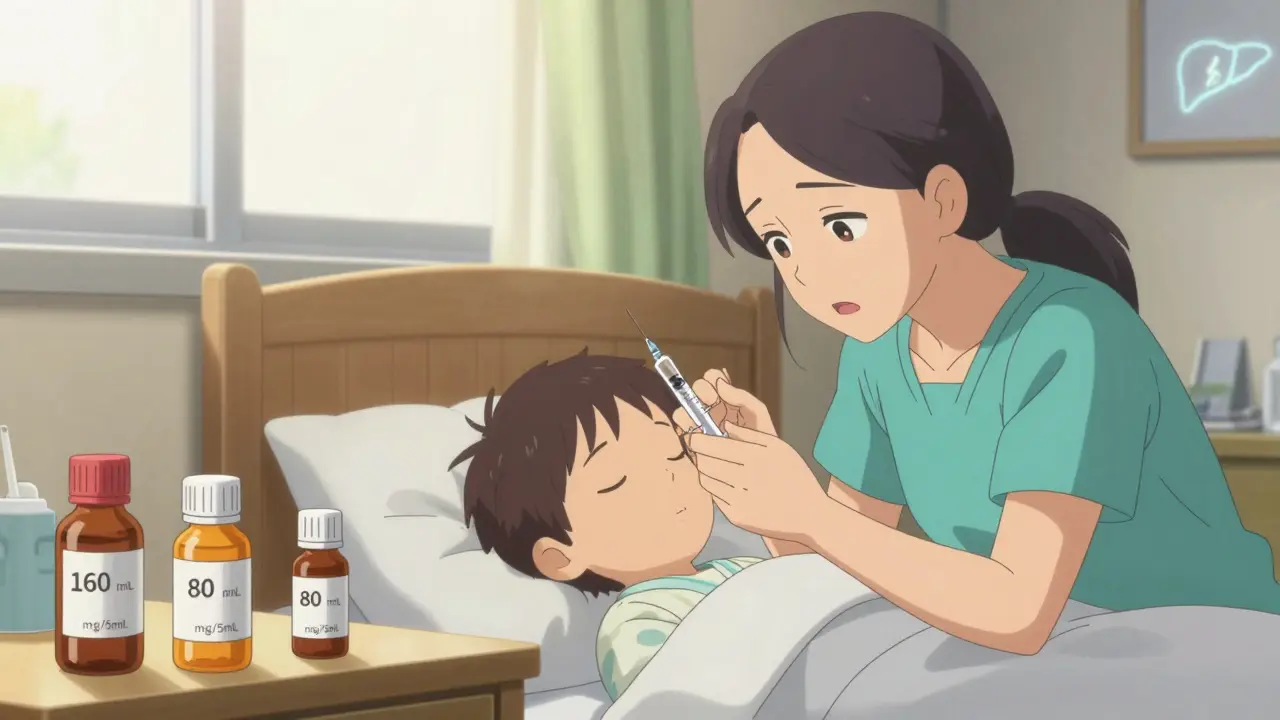
Here’s the catch: liquid formulations come in different strengths. Some are 160 mg per 5 mL, others are 80 mg per 5 mL. Mixing them up is one of the most common dosing errors. Always check the label. Use the measuring cup or syringe that comes with the bottle-never a kitchen spoon.
Ear Infections and Antibiotics
Ear infections are the #1 reason kids see a doctor. The American Academy of Pediatrics says amoxicillin is still first-line for most cases. But dosage depends on severity.
- Standard dose: 45 mg per kg per day, split into two doses (every 12 hours). For a 12 kg child, that’s 540 mg total per day-so 270 mg per dose.
- High-dose: 80-90 mg per kg per day for severe cases or if the child has had recent antibiotics. That’s 960-1,080 mg for a 12 kg child, split into two doses.
Amoxicillin-clavulanate (Augmentin) is used if the infection doesn’t improve. But the max single dose is capped at 875 mg, even for heavier kids. Fluoroquinolones like ciprofloxacin? Avoid under 18. They can damage growing cartilage.
Cough and Cold
Over-the-counter cough and cold medicines? Don’t give them to kids under 6. The FDA warns they’re not proven to work and can cause dangerous side effects like rapid heart rate and seizures. Even for older kids, the benefits are slim.
For a stuffy nose, use saline drops and a bulb syringe. For cough, honey works better than syrup for kids over 1 year. One teaspoon before bed reduces nighttime coughing better than dextromethorphan. And yes-never give honey to babies under 12 months. It can cause botulism.
Antivirals for Flu
If your child has the flu and is under 2 years or has asthma or another chronic condition, antivirals like oseltamivir (Tamiflu) may be recommended. It’s given as a liquid suspension.
- Infants 2 weeks to 1 year: 3 mg/kg twice daily for 5 days.
- Children 1-12 years: 3-5 mg/kg twice daily, depending on weight.
- Max single dose: 75 mg.
There’s a new version-fruit-flavored oseltamivir-that tastes like strawberry. One CDC study found it increased adherence by 58% in kids aged 2-7. That’s huge. If your child refuses medicine because it tastes awful, ask if a better-tasting version exists.
Medications to Avoid Completely
The Pediatric Pharmacy Association’s 2025 KIDs List is the gold standard for dangerous drugs in kids. Here are the big ones:
- Codeine and tramadol: Both are opioids. Some kids metabolize them too quickly, turning them into deadly amounts of morphine. Even a small dose can cause breathing to stop. Avoid in all children.
- Montelukast (Singulair): Used for asthma and allergies, but the FDA added a black box warning in 2020. It’s linked to mood changes, sleep disturbances, and suicidal thoughts in children and teens. Use only if other treatments fail.
- Angiotensin receptor blockers (like losartan): Avoid in babies under 1 month. Can cause kidney failure due to a rare condition called renal tubular dysgenesis.
- Mirabegron (Myrbetriq): Used for overactive bladder. Not studied in kids under 3. Avoid.
These aren’t "use with caution"-they’re "don’t even think about it." If your doctor prescribes one of these, ask why and if there’s a safer alternative.

Formulations Matter More Than You Think
A 5-year-old can’t swallow a 500 mg tablet. But a 10-year-old might be fine. That’s why formulations are designed by age group:
- Under 2 years: Liquid suspensions only. Chewables are a choking hazard.
- 2-5 years: Liquids or orally disintegrating tablets (ODTs). Some come in bubblegum or cherry flavors.
- 6-11 years: Chewables, ODTs, or small tablets. Some can swallow pills now.
- 12+ years: Standard tablets, capsules, or liquids. Same as adult forms, but often lower doses.
But here’s the problem: not all pharmacies stock the right formulations. A 2022 survey found 68% of pediatricians struggled to find the right dose for kids weighing 10-20 kg. That’s the sweet spot where most common illnesses hit. A child weighing 15 kg might need 2.5 mL of a 160 mg/5 mL suspension. But if the pharmacy only has the 80 mg/5 mL version, you have to give 5 mL. That’s double the dose.
Parents often use kitchen spoons or droppers from old bottles. A Children’s Hospital of Philadelphia study found 42% of caregivers made dosing errors because they didn’t use the right tool. Always use the syringe or cup that came with the medicine. Mark the dose with a Sharpie if needed.
Off-Label Use Is Common-But Not Risk-Free
Half of all medications given to kids aren’t officially approved for their age group. That’s called off-label use. It’s legal and often necessary because drug companies don’t always test medicines on children.
Neonates have the highest off-label rate-up to 90%. That’s because very few drugs are tested on newborns. But that doesn’t mean it’s safe. A 2023 study found off-label prescribing was linked to a 28% higher risk of adverse reactions in infants under 1 year.
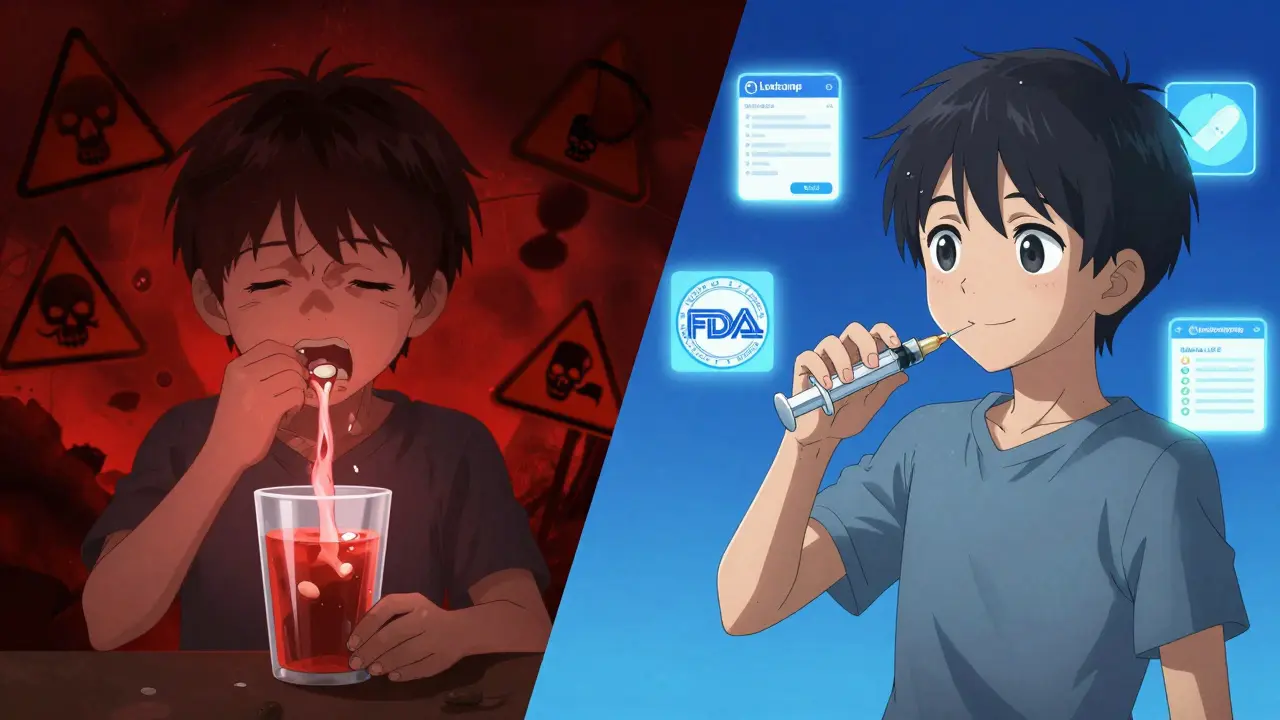
That’s why trusted resources like the Lexicomp Pediatric Dosage Handbook and the FDA’s Pediatric Dosing Calculator app are essential. They’re updated yearly and include weight-based dosing, max limits, and formulation notes. Most children’s hospitals use them. Community clinics? Only 38% do.
What Parents Can Do
You don’t need to be a pharmacist to keep your child safe. Here’s how:
- Always ask for the exact dose in milligrams per kilogram. Don’t accept "a teaspoon" or "half a pill."
- Use the measuring device that comes with the medicine. Never use a kitchen spoon.
- Check the concentration. Is it 160 mg/5 mL or 80 mg/5 mL? They’re not the same.
- Ask if there’s a better-tasting version. Flavor matters. If your child spits it out, they’re not getting the full dose.
- Keep a list of all meds. Include over-the-counter drugs, supplements, and herbal products. Share it with every doctor.
- Know the KIDs List. If a drug sounds risky, Google "KIDs List [drug name]"-you’ll find the official warning.
The Future of Pediatric Medicines
Things are improving. Since the Pediatric Research Equity Act passed in 2003, 89% of new drugs now include pediatric studies-up from just 12%. Companies are designing better-tasting liquids, dissolvable tablets, and even 3D-printed pills that can be customized for a child’s exact weight.
One hospital in Cincinnati is testing nanoparticle delivery systems that let drugs absorb more easily in babies with underdeveloped guts. The WHO aims to get 90% of essential pediatric medicines available in low-income countries by 2030. Right now, only 34% are available there versus 92% in high-income countries.
But the biggest change isn’t technological-it’s cultural. We’re finally treating kids as their own category of patient, not just small adults. And that’s making all the difference.
Can I give my child adult ibuprofen if I cut the pill in half?
No. Adult ibuprofen tablets are 200 mg each. Cutting them in half gives you 100 mg, but that’s still not accurate for most kids. Children need doses based on weight-not half a pill. A 15 kg child needs 75-150 mg per dose. A 200 mg tablet cut in half is 100 mg, which might be close-but what if your child weighs 12 kg? That’s only 60-120 mg needed. You’re guessing. Use a liquid formulation with a syringe for precision.
Why is my child’s antibiotic liquid so bitter?
Many antibiotics, like amoxicillin, are naturally bitter. That’s why manufacturers add flavoring-but not all pharmacies use the best ones. Ask your pharmacist if a better-tasting version is available. Some pharmacies can compound medications with flavors like grape, bubblegum, or chocolate. The CDC found that flavored oseltamivir increased adherence by 58%. Taste isn’t just about comfort-it’s about getting the full dose.
Is it safe to use leftover antibiotics from a previous illness?
No. Antibiotics are prescribed for a specific infection, weight, and duration. Using old medicine means you’re not sure of the correct dose, whether it’s still effective, or if it’s the right drug for the current illness. Plus, antibiotics expire. Even if they look fine, they can lose potency. Using them incorrectly contributes to antibiotic resistance, which kills 35,000 people in the U.S. every year.
What should I do if I give my child the wrong dose?
Call Poison Control immediately at 1-800-222-1222 (U.S.) or your local emergency number. Don’t wait for symptoms. Even small overdoses of acetaminophen or ibuprofen can cause liver or kidney damage. If your child is having trouble breathing, turning blue, or is unusually sleepy, call 911. Keep the medicine bottle handy so you can tell them exactly what was given and how much.
Are herbal remedies safe for children?
Not without medical advice. Many herbal products aren’t tested in children. Echinacea, elderberry, and chamomile may seem natural, but they can interact with prescription meds or cause allergic reactions. A 2023 study found that 1 in 5 pediatric ER visits for herbal products involved children under 5. Always tell your doctor if your child is taking any supplement-even if you think it’s harmless.
Final Thoughts
Getting medication right for kids isn’t about being perfect-it’s about being careful. Every dose matters. Every milliliter counts. The system isn’t flawless-formulations are still limited, off-label use is common, and taste is still a huge barrier. But we’ve come a long way from the days of crushing adult pills. Today, we have guidelines, tools, and experts focused on making sure children get medicines that are safe, effective, and actually tolerable. Trust the data. Use the right tools. Ask questions. And remember: your child’s body isn’t a smaller version of yours. It deserves its own medicine.

Man, I just read this and thought about how my sister gave her kid adult ibuprofen once because she "didn’t have the kid stuff" on hand. Thank god nothing happened. But this post? Absolute lifesaver. I’m printing this out and taping it to the fridge next to the cereal box.
Also, honey for cough? I’m trying that tonight. My kid hates medicine but loves sticky stuff.
Also also - why does everything taste like regret?
Also also also - why do pharmacies still not have the right concentrations? I’m tired.
Anyway. Thanks for not being a robot.
life is just a series of tiny liquid doses and unspoken fears 🍯💊
we used to crush pills like it was a ritual 🤭
now i cry when my baby spits out medicine 😭
but honey? yes. honey is the real MVP 🐝
also why do we still call it "off-label" like it’s a crime? 🤷♀️
they’re not mini adults they’re tiny humans with tiny livers 🧬
and someone needs to make a flavor that doesn’t taste like sadness
thank you for this post 🙏
This made me feel better. I was so scared I was doing it wrong. I didn’t know about the different concentrations. I thought all children’s Tylenol was the same. Now I check the bottle every time. I even marked my syringe with tape so I don’t mess up. My son is 3 and he hates medicine, but he’ll take it if it’s grape. I didn’t know that was a thing. Thank you for telling us what to do. Not just what not to do.
Also, no more kitchen spoons. Ever.
Always use weight-based dosing. Never volume-based. Never guess. Always use the syringe. Always check concentration. Always ask if there’s a better flavor. Always keep a med list. That’s it. No fluff. Do these six things and you’re already ahead of 80% of parents.
Also - no codeine. Ever. Not even once. It’s not a debate.
Okay but let’s be real - this whole system is a dumpster fire. Why does it take a PhD to figure out how much Tylenol to give a 17kg toddler? Why is there no universal standard? Why do pharmacies stock only two concentrations and expect parents to do math like it’s 1987? Why is there a fruit-flavored Tamiflu but no chocolate-flavored amoxicillin? Why does my 5-year-old gag at the sight of a dropper? Why is the KIDs List buried in a PDF no one reads? Why does the FDA let companies make medicine that tastes like battery acid and call it "pediatric-friendly"? Why is off-label use so common because nobody wants to pay for pediatric trials? Why do we still have to Google "is this safe for kids" at 2 a.m. while holding a sobbing child? Why is this even a thing? We’re not even trying. We’re just hoping. And someone wrote a 2,000-word essay about it like it’s a TED Talk. I’m exhausted. I just want my kid to get better without becoming a pharmacist.
How quaint. A post that treats children as sentient beings with unique physiology - how novel. The medical establishment has spent decades treating pediatric patients as scaled-down adults, and now, in 2025, we’re shocked to discover that biology isn’t linear? How dare they? The fact that this information requires a 12-section manifesto to be communicated to parents speaks volumes about the systemic negligence of pharmaceutical capitalism. You don’t need a syringe - you need a revolution. The KIDs List is not a checklist; it’s a eulogy for generations of children who were dosed like lab rats. And let’s not pretend flavoring matters - it’s a Band-Aid on a hemorrhage. The real issue? We commodify suffering. We market syrup to children while denying them proper clinical research. This isn’t about dosing. It’s about dignity. And dignity, my dear, is not measured in milligrams per kilogram - it’s measured in how much society cares to look away.
I’m from Indonesia and we don’t have many pediatric meds here. My cousin’s baby got sick and they gave him adult medicine because the clinic was out of kids’ stuff. He was fine, but I cried for three days. This post? I shared it with my whole family. We don’t have fancy syringes. We use eyedroppers from old bottles. But now we know - we check the concentration. We ask for flavors. We don’t use honey for babies. We Google "KIDs List" now. Thank you. I wish this was in every clinic in my country.
Also - why is honey so magical? 🍯✨
Look - you’re not alone. Every parent who’s ever stared at a medicine bottle at 3 a.m. wondering if they gave too much? You’re doing better than you think.
Here’s your next move: Write down every med your kid takes - even the gummy vitamins. Bring it to every appointment. Ask the pharmacist: "Is there a better-tasting version?" If they say no, ask for another pharmacy. Call your pediatrician and say: "I need the exact mg/kg dose written out." Don’t be shy.
And if you’re stressed? Breathe. You’re not failing. You’re learning. This isn’t a test. It’s a journey. And you’re not doing it alone.
Also - honey works. Try it. Your kid will thank you. And so will your sleep schedule.