
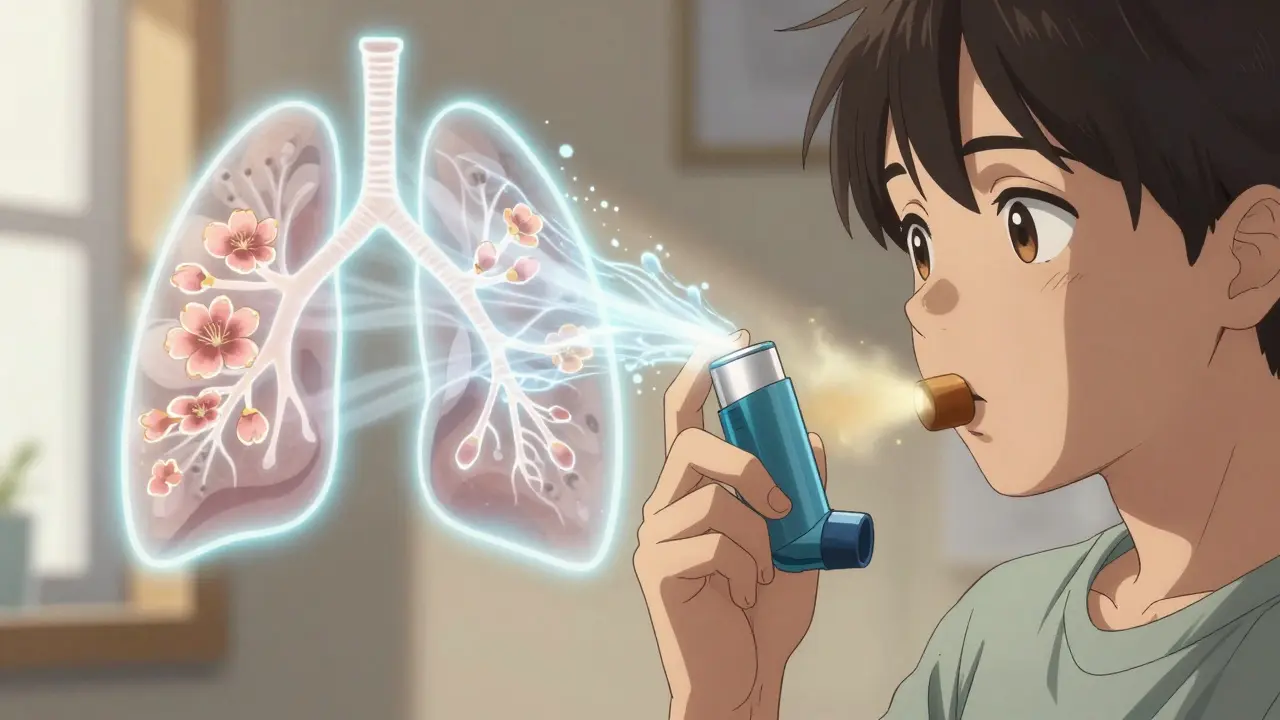
If you or someone you know uses an inhaler for asthma or COPD, you’ve probably seen two different colors - one blue, one brown. But do you know why both are needed? Many people think the blue inhaler is the only one that matters because it gives instant relief. The brown one? They assume it’s just extra. That’s a dangerous misunderstanding. Bronchodilators and corticosteroids don’t do the same thing. They don’t even work the same way. And using them wrong can make your condition worse - not better.
What Bronchodilators Actually Do
Bronchodilators are fast-acting. They’re your rescue team. When your airways tighten up - maybe from exercise, cold air, or an allergen - these drugs step in and tell the muscles around your airways to relax. Think of it like loosening a clenched fist. The airway opens. You can breathe easier. Within 15 to 20 minutes, you’ll feel it.
The two main types are beta-2 agonists and anticholinergics. Albuterol (also called salbutamol) is the most common beta-2 agonist. It’s in your blue inhaler. It works by activating receptors in your lungs that trigger a chain reaction inside cells, leading to muscle relaxation. Long-acting versions like salmeterol or formoterol last 12 hours or more. But here’s the catch: they’re not meant to be used alone for asthma. Studies show using long-acting bronchodilators without an anti-inflammatory drug increases the risk of asthma-related death by 3.5 times. That’s why they’re always paired with corticosteroids in combination inhalers like Advair or Symbicort.
Anticholinergics like ipratropium and tiotropium work differently. Instead of stimulating receptors, they block signals that cause airway tightening. These are often used in COPD, especially in older patients. Tiotropium, for example, lasts a full 24 hours. That’s why it’s in once-daily inhalers like Spiriva.
What Corticosteroids Actually Do
Corticosteroids don’t open your airways. They don’t give you quick relief. What they do is quieter - and far more important long-term. They fight the inflammation that’s always there in asthma and COPD. Even when you feel fine, your airways are swollen, sensitive, and full of mucus. Over time, that inflammation causes permanent damage. Corticosteroids stop that process.
When you inhale fluticasone, budesonide, or beclomethasone, the drug enters your lung cells and binds to receptors that control inflammation genes. It turns down over 100 genes that cause swelling and turns up genes that reduce it. The result? Less mucus, less swelling, fewer flare-ups. But it takes weeks. You won’t feel better right away. That’s why people stop using them. They think they’re not working. But if you skip doses, your airways go back to being inflamed. Your symptoms return. Your risk of hospitalization goes up.
Studies show regular use cuts asthma exacerbations by 30% to 60%. For COPD patients with frequent flare-ups, it reduces hospital visits by nearly half. The catch? These drugs are only effective if they reach deep into the small airways. That’s why technique matters more than you think.

Why Timing Between Inhalers Matters
Here’s the most overlooked part: order matters. Always use your bronchodilator first. Wait five minutes. Then use your corticosteroid.
Why? Because when your airways are tight, the corticosteroid can’t get where it needs to go. It hits the big airways and gets stuck. But if you open the airways first with a bronchodilator, the corticosteroid can travel deeper - into the tiny bronchioles where inflammation is doing the most damage. A 2023 Cleveland Clinic study found patients who followed this sequence had 40% better drug delivery in their lungs.
And don’t forget to rinse your mouth after the corticosteroid. Swish with water and spit it out. Not swallow. This simple step cuts the risk of oral thrush - a fungal infection that causes white patches and soreness - by over 70%. About 42% of users get thrush because they skip this step. It’s not rare. It’s preventable.
Combination Inhalers: The New Standard
Today, most people with persistent asthma or moderate-to-severe COPD use combination inhalers. These devices deliver both a bronchodilator and a corticosteroid in one puff. Advair (fluticasone/salmeterol), Symbicort (budesonide/formoterol), and Breo Ellipta (fluticasone/vilanterol) are the most common.
They’re convenient. But they’re not magic. You still need to use them right. And you still need to know which one is for daily use and which is for emergencies. That’s where confusion sets in. A 2022 American Lung Association survey found only 47% of patients could correctly identify which inhaler was which.
There’s also a new category: as-needed combination inhalers. Airsupra (albuterol/budesonide) was approved by the FDA in 2023. It’s designed to be used only when symptoms appear. It gives quick relief and delivers anti-inflammatory medicine at the same time. GINA 2023 guidelines now recommend this approach for mild asthma instead of using a rescue inhaler alone. The SYGMA trials showed it reduces severe flare-ups by 64% compared to albuterol-only use.

Side Effects and Real-World Problems
No medication is without trade-offs. Bronchodilators like albuterol can cause shaky hands, a racing heart, or nervousness. These usually fade after a few days. But if you’re using your rescue inhaler more than 2-3 times a week, you’re not controlling your disease - you’re just masking it. That’s a red flag.
Corticosteroids have their own risks. Hoarseness and throat irritation are common. Oral thrush is avoidable with rinsing. But there’s a bigger concern: pneumonia risk. In COPD patients over 65 using high-dose inhaled steroids, the risk goes up by 70%. That’s why doctors now avoid high doses unless absolutely necessary.
And then there’s the environmental cost. A single albuterol inhaler has the same carbon footprint as driving 300 miles. That’s why dry powder inhalers (DPIs) are replacing old metered-dose inhalers (MDIs). DPIs don’t use propellants. They’re greener. And since 2020, 45% of new inhalers launched are DPIs.
What You Need to Do Right Now
If you’re on these medications, here’s what to check:
- Know your colors. Blue = rescue. Brown or white = daily controller. If you’re unsure, ask your doctor or pharmacist.
- Use bronchodilator first. Wait five minutes. Then use your corticosteroid. This isn’t optional. It’s science.
- Rinse and spit. After every corticosteroid puff. No exceptions.
- Track your rescue inhaler use. If you’re using it more than twice a week (outside of exercise), your control is poor. Talk to your doctor.
- Practice your technique. Only 31% of people use inhalers correctly without training. Watch a video from the American Lung Association or ask for a demo at your pharmacy.
There’s no magic pill. But these two types of medications - when used properly - can let you live without constant wheezing, coughing, or fear of an attack. They don’t cure asthma or COPD. But they give you back your life.
Can I use a bronchodilator every day instead of a corticosteroid?
No. Bronchodilators only open your airways temporarily. They don’t reduce the underlying inflammation that causes long-term damage. Using them daily without a corticosteroid is dangerous. It masks worsening disease and increases your risk of severe asthma attacks and death. Always use corticosteroids for daily control if prescribed.
Why does my corticosteroid inhaler taste weird?
The taste comes from the medication itself - usually a steroid like fluticasone or budesonide. It’s not harmful, but it can be unpleasant. Rinsing your mouth after use helps remove the residue and reduces side effects like hoarseness or thrush. Some people find that using a spacer makes the taste less intense because less drug sticks to the back of the throat.
How long until I feel the full effect of my corticosteroid?
It takes 1 to 4 weeks of daily use to see the full benefit. You won’t feel better right away. That’s normal. Don’t stop using it because you don’t feel a difference. The goal isn’t to feel better immediately - it’s to prevent flare-ups, hospital visits, and long-term lung damage. Stick with it.
Is it okay to share my inhaler with someone else?
Never share inhalers. Even if the person has similar symptoms, the dosage, type of medication, and medical history are different. Sharing increases the risk of infection - especially fungal infections like thrush - and can lead to dangerous overdoses or underdosing. Each inhaler is prescribed for one person only.
What if I forget to wait 5 minutes between inhalers?
If you forget, don’t panic. Just use them in the right order next time. But understand that you’re not getting the full benefit. The corticosteroid won’t reach deep into your lungs as effectively. Setting a phone reminder or placing a sticky note on your inhaler case can help. Some newer inhalers even have built-in timers or apps to guide you.
Can I stop taking my corticosteroid if I feel fine?
No. Feeling fine means the medication is working. Stopping it suddenly can cause your inflammation to return quickly, leading to a flare-up. If you want to reduce or stop it, talk to your doctor. They may slowly lower your dose while monitoring your symptoms. Never stop on your own.



Bronchodilators are beta-2 agonists that bind to G-protein-coupled receptors on airway smooth muscle, triggering cAMP-mediated relaxation via PKA. Corticosteroids, like fluticasone, translocate to the nucleus and bind glucocorticoid receptors, suppressing NF-κB and AP-1 transcription factors that drive pro-inflammatory cytokine expression. The synergy isn't just additive-it's multiplicative. Without corticosteroids, chronic bronchodilator use upregulates beta-receptor desensitization, leading to tachyphylaxis and increased mortality. This is evidence-based, not anecdotal.
bro i just learned this today and holy crap. i been using my blue inhaler like a candy and my brown one? i forget like 3 days a week. no wonder i keep wheezing after gym. gonna start rinsing my mouth too-my throat’s been itchy for months. thanks for the clarity 😅
As someone who’s lived with asthma since childhood and now teaches respiratory therapy in rural clinics, I’ve seen this pattern everywhere-blue inhaler as a magic wand, brown one as an optional luxury. In India, I watched a 72-year-old man stop his corticosteroid because he ‘felt fine’ after a month. He ended up in the ER with status asthmaticus. The science is clear: inflammation doesn’t announce itself before it collapses your lungs. Consistency isn’t discipline-it’s survival.
And yes, technique matters more than the device. I’ve had patients use spacers like water bottles. One guy held his inhaler 6 inches from his mouth and said ‘it’s just the same.’ No. It’s not. You’re wasting 80% of your dose. Watch the ALA video. Do it.
So let me get this straight-my 300-mile carbon footprint inhaler is ‘greener’ than the one that’s been saving my life since 2018? Cool. Next you’ll tell me my oxygen tank is a climate villain. Meanwhile, my lungs are still breathing because of this junk. Thanks, Green New Deal.
There’s a deeper truth here that rarely gets discussed: we treat lungs like machines, but they’re living tissue. Bronchodilators are like slamming the gas pedal. Corticosteroids are like tending the soil so the engine doesn’t rust from within. We’ve normalized emergency responses as daily habits because we’ve forgotten how to prevent decay. The real tragedy isn’t the misuse-it’s the normalization of chronic crisis as the new normal.
When we stop seeing inflammation as a silent war and start treating it as a signal, we stop being patients and become stewards of our own biology. That shift-from reactive to regenerative-is what medicine should be.
Blue = emergency, brown = daily. Rinse after brown. Wait 5 min. If you’re using blue more than twice a week, call your doc. That’s it. No fluff. Just do it.
For those wondering about DPIs vs MDIs: DPIs require a strong, fast inhale-so if you’re elderly or have weak lung capacity, they won’t work. MDIs with spacers are still gold standard for many. Don’t switch just because it’s ‘trendy.’ Your technique matters more than the device. Ask your pharmacist to watch you inhale. Seriously. Most of us do it wrong.
And if you think ‘I don’t need the brown one because I’m not wheezing’-you’re lying to yourself. Inflammation doesn’t cough. It just waits.
OMG i just realized i been swallowing the rinse water after my brown inhaler 😭 i thought it was just ‘to wash the taste’ but now i get why i got that weird mouth sore. gonna start spitting from now on. thanks for the heads up!!
Who the hell wrote this? Some pharma shill trying to sell combo inhalers? My grandpa used a blue inhaler for 40 years and never once used a brown one. He lived to 91. You’re scaremongering with ‘3.5x death risk’-that’s a lab stat, not real life. Stop pushing meds on people who don’t need ‘em.
And why the hell do we need a 5-minute wait? Sounds like a corporate protocol to make you use more puffs. I’ve been puffing blue then brown back-to-back since ‘97. Still breathing. You’re overcomplicating it.
Grandpa lived to 91 despite the regimen, not because of it. He was an outlier. The 3.5x risk is from the SMART trial, published in NEJM-double-blind, placebo-controlled, 12,000+ patients. Anecdotes are not data. And the 5-minute wait? It’s not corporate-it’s pulmonary physiology. A 2023 micro-CT study showed 40% less deposition in distal airways when corticosteroids were administered without prior bronchodilation. Your grandpa got lucky. Don’t gamble with your lungs.
Wait… so the ‘brown’ inhaler is really a steroid? Like… the same ones they give bodybuilders? And they’re telling us to inhale it? What if it’s just a slow-acting poison? What if the ‘inflammation’ is actually the body fighting off EMF from 5G towers? They’ve been hiding this for decades. My cousin’s neighbor’s dog got thrush after using one. Coincidence? I think not.
For anyone feeling overwhelmed-this isn’t about perfection. It’s about progress. Missed a rinse? Do it tomorrow. Forgot the 5-minute wait? Just do it right next time. You’re not failing. You’re learning. Your lungs don’t need a perfect patient. They need a persistent one.
And if you’re reading this and thinking ‘I can’t afford these inhalers’-you’re not alone. Ask your pharmacist about patient assistance programs. Most manufacturers offer free or low-cost options. You deserve to breathe without debt.
I’ve been using my inhalers for 15 years. I’ve never rinsed. Never waited. Never tracked usage. And yet-I’ve never been hospitalized. So why are you telling me I’m doing it wrong? Are you trying to make me feel guilty? I’m not a statistic. I’m a person who’s been breathing just fine. Don’t lecture me.
People like you who think they’re ‘fine’ are the reason ERs are full. You’re not a person-you’re a walking public health liability. You’re not just risking your own life-you’re risking others’ when you have an attack in a crowded place. You think your ‘I’m fine’ attitude is brave? It’s selfish. And you’re lucky no one’s died because of you.