

Autoimmune uveitis isn't just a simple eye infection. It's a serious condition where your immune system mistakenly attacks the uvea - the middle layer of your eye that includes the iris, ciliary body, and choroid. This leads to inflammation that can blur your vision, cause pain, and even lead to permanent vision loss if not managed correctly. Unlike infections that need antibiotics, autoimmune uveitis requires a completely different approach: steroid-sparing therapy.
What Happens When Your Immune System Attacks Your Eye
The uvea is rich in blood vessels and pigmented cells, making it a prime target for immune system confusion. In autoimmune uveitis, your body starts treating normal eye tissue as a threat. This isn't random - it's often linked to other autoimmune diseases. About half of all cases are connected to conditions like ankylosing spondylitis, rheumatoid arthritis, lupus, Crohn’s disease, or sarcoidosis. Even psoriasis and multiple sclerosis can trigger it. The inflammation doesn't always show up in both eyes at once. Sometimes it starts in one, then spreads. Symptoms can sneak up slowly or hit hard: redness, light sensitivity, floaters, blurred vision, eye pain, and headaches. If you notice any of these lasting more than a few days, don’t wait. Early diagnosis is the key to saving your vision.Why Steroids Are the First Line - But Not the Long-Term Solution
Corticosteroids are the go-to treatment for acute uveitis. Eye drops for front-of-the-eye inflammation, injections near the eye for deeper involvement, or pills for widespread disease - steroids work fast. They bring down inflammation like a fire extinguisher. But here’s the catch: they don’t fix the root problem. They just suppress the symptoms. And the longer you use them, the more damage they cause. Long-term steroid use raises your risk of cataracts, glaucoma, bone thinning, weight gain, high blood sugar, and even mood swings. For someone with chronic uveitis, staying on steroids for months or years isn’t just risky - it’s dangerous. That’s why doctors don’t stop at steroids. They plan ahead.Steroid-Sparing Therapy: The Real Game-Changer
Steroid-sparing therapy means using other drugs that calm the immune system so you can reduce or stop steroids altogether. This isn’t experimental. It’s standard care now. The big breakthrough came in 2016 when the FDA approved Humira (adalimumab) for non-infectious uveitis. Humira blocks TNF-alpha, a protein that fuels inflammation. For many patients, it’s a game-changer. One study from UT Southwestern showed pediatric patients on infliximab - another TNF inhibitor - cut their steroid use by over 70% and had far fewer flare-ups. Methotrexate and cyclosporine are older options still used today. They’re cheaper and have been around longer, but they need regular blood tests to monitor liver and kidney function. Biologics like Humira and infliximab are more targeted, which means fewer side effects on the rest of the body. But they’re expensive and require injections or infusions.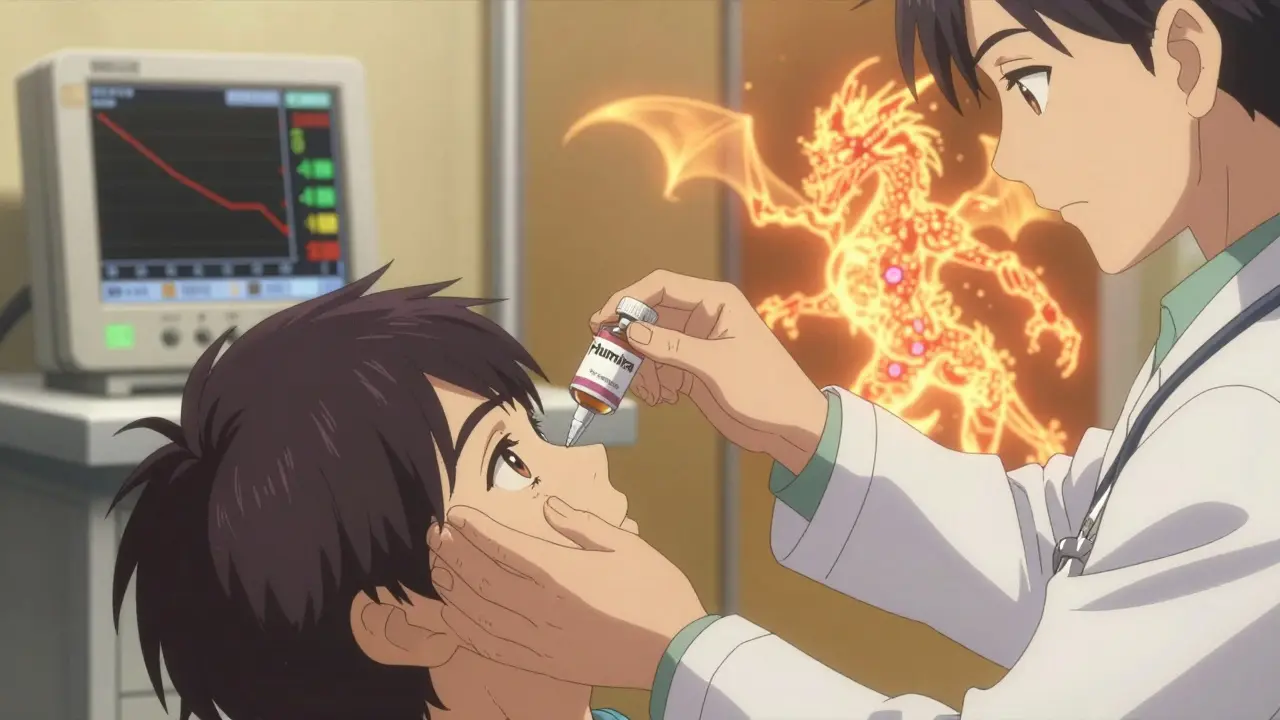
How Doctors Decide What Treatment Is Right for You
There’s no one-size-fits-all plan. Your treatment depends on three things: where the inflammation is, how bad it is, and whether you have another autoimmune disease. Anterior uveitis (front of the eye) might start with drops. Posterior uveitis (back of the eye) often needs injections or pills right away. If you have Crohn’s disease and uveitis, your rheumatologist and ophthalmologist will work together. That’s not optional - it’s essential. Studies show patients who see both specialists have fewer flare-ups and better long-term outcomes. Blood tests, eye scans like OCT, and fluorescein angiography help rule out infections like tuberculosis or herpes. You can’t treat autoimmune uveitis the same way you treat an infected eye. Mistaking one for the other could make things worse.What You Can Expect During Treatment
Starting steroid-sparing therapy isn’t a quick fix. It takes weeks to months to work. You’ll still need steroids at first to get inflammation under control. Then, as the new drug kicks in, your doctor slowly tapers your steroids. This process can be nerve-wracking. Some patients feel worse before they feel better. That’s normal. Your doctor will monitor you closely - usually every few weeks at first. You’ll need regular eye exams to check pressure, clarity, and retinal health. Blood tests will track liver enzymes, white blood cell counts, and signs of infection. Because these drugs suppress your immune system, you’re more vulnerable to colds, flu, and even rare infections. Vaccines (like flu and pneumonia shots) are recommended, but live vaccines are a no-go. If you develop a fever, night sweats, or unexplained fatigue, call your doctor immediately.
The Growing Landscape of New Treatments
The field is moving fast. Humira was the first biologic approved for uveitis, but it’s not the only one. At least seven other drugs are in clinical trials, targeting different parts of the immune system. Some block interleukins like IL-6 or IL-17. Others inhibit JAK-STAT pathways - the same ones targeted by drugs for rheumatoid arthritis. Early results show promise for patients who don’t respond to TNF inhibitors. There’s also growing interest in personalized medicine. Researchers are looking at genetic markers and blood proteins to predict who will respond best to which drug. This could mean fewer trial-and-error cycles and faster relief. In 2023, there were over 50 specialized uveitis clinics in the U.S., up from just 15 in 2010. More clinics mean better access to experts who know how to manage these complex cases.Why This Matters: Saving Vision, Not Just Controlling Symptoms
Autoimmune uveitis affects fewer than 200,000 people in the U.S. That’s why it’s called an orphan disease - it doesn’t get the attention or funding of more common conditions. But for those it affects, it’s life-changing. Vision loss isn’t just about not seeing clearly. It’s about losing independence, driving, reading, recognizing faces. Steroid-sparing therapy isn’t about avoiding steroids because they’re bad. It’s about replacing them with something that treats the disease, not just the symptoms. It’s about giving patients back control - over their eyes, their health, and their lives.Can autoimmune uveitis be cured?
There’s no cure for autoimmune uveitis, but it can be managed effectively. With the right combination of steroid-sparing therapies and close monitoring, many patients achieve long-term remission. The goal isn’t to eliminate the disease entirely - it’s to keep inflammation under control so vision stays intact.
How long does steroid-sparing therapy take to work?
It usually takes 4 to 12 weeks before you notice improvement. Drugs like methotrexate or Humira don’t work like eye drops - they change how your immune system behaves over time. Patience is key. Your doctor will adjust dosages and monitor your progress with regular tests and eye exams.
Are there side effects from steroid-sparing drugs?
Yes. Immunosuppressants and biologics increase your risk of infections like pneumonia or reactivated tuberculosis. Some can affect liver function or lower blood cell counts. Regular blood tests and screenings are required. But these risks are often lower than the long-term damage from steroids - which is why they’re used.
Do I need to see a rheumatologist if I have uveitis?
If your uveitis is linked to an autoimmune disease like lupus or Crohn’s, absolutely. Even if you don’t have symptoms elsewhere, your eye inflammation might be the first sign of a systemic condition. Rheumatologists help identify underlying causes and coordinate treatment with your eye doctor. Studies show this teamwork reduces flare-ups by up to 40%.
What happens if I stop my medication too soon?
Stopping treatment early is one of the most common reasons uveitis comes back. These drugs work by slowly calming the immune system. If you stop before your body adjusts, inflammation can return - sometimes worse than before. Always follow your doctor’s plan for tapering. Never stop on your own, even if you feel fine.



Steroid-sparing therapy is a game-changer for chronic uveitis patients. I’ve seen too many people stuck on prednisone for years, then end up with cataracts and osteoporosis before anyone even considered switching. The real win is when rheumatology and ophthalmology teams collaborate - it’s not optional, it’s foundational.
The reliance on TNF-alpha inhibitors like Humira is textbook immunological reductionism. We’re treating a systemic autoimmune cascade with a single cytokine blockade - a crude approximation at best. The real paradigm shift lies in multi-targeted immunomodulation, not monotherapy. Methotrexate remains underutilized due to institutional inertia and pharmaceutical marketing bias.
Biologics are not panaceas. They’re expensive, require cold-chain logistics, and carry latent TB risks. Yet we’ve institutionalized them as first-line without robust comparative effectiveness data. This is not medicine - it’s market-driven protocol.
And don’t get me started on the JAK inhibitors. IL-6 blockade is promising, but we’re still in the era of empirical immunosuppression. We need precision phenotyping: transcriptomic profiling of uveitic aqueous humor, not just HLA typing.
Most clinics still rely on OCT and fluorescein angiography as gold standards. But we’re missing the epigenetic markers, the microRNA signatures, the B-cell clonality patterns. This is 2024. We should be doing single-cell RNA-seq on anterior chamber lavage, not just praying the patient doesn’t flare.
And yes, I’ve published on this. In Nature Reviews Rheumatology. Twice.
My sister’s been on Humira for 3 years now. Her uveitis hasn’t flared once since she switched. She still gets the occasional headache but no more blurred vision. I cried when she said she could read her kid’s school report again 😭
It’s not perfect - she’s had two UTIs and had to skip her flu shot - but it’s given her life back. I wish more people knew this was an option.
Steroids are a bandaid. Biologics are the real fix.
so i had uveitis last year and my doc put me on methotrexate and i was like wow this is gonna be rough but honestly? it was kinda chill. i just had to get blood work every 2 weeks and i stopped the steroids super slow like over 6 months. now i’m off everything and my eyes are fine. i still get nervous when my vision gets blurry but i know what to do now. also i got a tattoo of an eye on my wrist to remind me to take care of myself 🖤👁️
Interesting how this mirrors the shift we saw in RA and psoriasis over the last two decades. We used to just manage symptoms. Now we target disease pathways. Uveitis is catching up. The fact that we have 50+ specialized clinics in the U.S. now? That’s progress. Still, access is wildly uneven. Rural patients? Still stuck with local ophthalmologists who’ve never seen a biologic in person.
OMG this is SO important!! 🙌 I’ve been advocating for autoimmune eye care for years and no one listens. But this? This is the kind of info that needs to go viral. Imagine if every ER doc knew to check for uveitis in someone with joint pain and red eyes. We could prevent SO much blindness. I’m sharing this with my whole network. #VisionMatters #AutoimmuneAwareness
Biologics? Costing $20k a year? In America, we’re paying for this while other countries ration care. We need to stop letting Big Pharma dictate treatment. Methotrexate works. It’s been around since the 60s. Why are we chasing expensive toys? This isn’t medicine - it’s capitalism disguised as innovation.
And don’t get me started on the ‘personalized medicine’ hype. We’re not curing cancer here. We’re managing inflammation. Let’s stop pretending we’re doing magic.
It’s fascinating how this reflects the broader tension in medicine: intervention vs. observation. We want to fix, to alter, to control - but autoimmune disease is systemic, dynamic, and often unpredictable. Is suppressing TNF-alpha really addressing the root? Or just the symptom of a deeper dysregulation? Perhaps the real breakthrough isn’t another drug - but a shift in how we conceptualize immune tolerance.
What if the goal isn’t to silence the immune system, but to restore its memory? To teach it, not suppress it?
Everyone’s acting like Humira is some miracle drug. Newsflash: it’s just another immunosuppressant. And we’re not even talking about the long-term cancer risk. The FDA approved it based on short-term trials. We’re gambling with people’s lives because we’re desperate for something - anything - that works.
And the ‘steroid-sparing’ label? That’s PR. It’s not sparing - it’s replacing one set of risks with another. And don’t even get me started on the 7 drugs in trials. Another 10 years of clinical trials before any of them hit the market. Meanwhile, patients are going blind.
I’ve been reading up on this since my diagnosis last year. I don’t have another autoimmune condition, but my uveitis was bilateral and chronic. I started on methotrexate and it took 3 months to even notice a difference. I thought I was failing - until my ophthalmologist showed me the OCT scans. My retinal thickness had improved by 18%. I didn’t feel it, but my body did.
It’s not about how you feel. It’s about what the scans show. That’s what I had to learn.
i just want to say thank you for writing this. i was scared to ask my doc about switching from steroids because i thought they’d think i was being difficult. but reading this made me feel like it’s okay to want more than just symptom control. i started methotrexate last month and i’m nervous but hopeful. also i made a playlist called ‘my eyes are healing’ 🎧👁️💕
Been managing uveitis for 12 years. Methotrexate. Then Humira. Now on a JAK inhibitor. Side effects? Yes. But I can drive at night again. I can read my granddaughter’s handwriting. Worth every blood test, every injection. Just… don’t give up.
The notion that steroid-sparing therapy constitutes a paradigm shift is fundamentally flawed. The underlying pathophysiology remains unaddressed. The reliance on biologics reflects a pharmaceutical-industrial complex prioritizing profit margins over mechanistic understanding. The true frontier lies in antigen-specific tolerance induction - a domain still in its infancy, yet vastly underfunded compared to cytokine blockade.
One must question the epistemological foundation of current clinical protocols. Are we treating patients - or biomarkers?