
GLP-1 Gallbladder Symptom Checker
This tool helps you assess whether your abdominal symptoms might be related to gallbladder issues while using GLP-1 medications. Based on the latest medical research, please select any symptoms you're experiencing.
When you start a GLP-1 agonist like Ozempic or Wegovy for weight loss or diabetes, the goal is clear: lose weight, improve blood sugar, feel better. But for some, a quiet danger creeps in-abdominal pain that doesn’t go away. It’s not just indigestion. It could be your gallbladder screaming for help.
Why GLP-1 Agonists Put Your Gallbladder at Risk
GLP-1 agonists work by slowing digestion and reducing appetite. That’s great for weight loss, but it also slows down your gallbladder. Normally, when you eat, especially fatty foods, your gallbladder contracts and releases bile to help digest fats. GLP-1 drugs suppress the hormone cholecystokinin, which tells your gallbladder to squeeze. Without that signal, bile sits still. Stagnant bile turns into sludge, then stones. A 2022 meta-analysis in JAMA Internal Medicine looked at 76 clinical trials involving over 56,000 people. It found a 37% higher risk of gallbladder disease with GLP-1 agonists compared to placebo. That might sound small, but when you’re talking about millions of users, it adds up. The absolute risk? About 1 in 100 people on weight-loss doses like Wegovy (2.4 mg semaglutide) develop gallstones. For those on lower diabetes doses, it’s closer to 1 in 300.Which GLP-1 Drugs Carry the Highest Risk?
Not all GLP-1 agonists are the same when it comes to gallbladder danger. Liraglutide (Victoza, Saxenda) shows the highest relative risk-more than double that of placebo. Semaglutide (Ozempic, Wegovy) is close behind. Exenatide (Byetta, Bydureon) has a much lower signal. Why? Dose matters. The 3.0 mg liraglutide and 2.4 mg semaglutide doses approved for weight loss are stronger than the 0.5-1.0 mg doses used for diabetes. Higher doses mean more suppression of gallbladder movement. That’s why the risk jumps from 0.3% in diabetes trials to 1.3% in weight loss trials.Red Flags: When Abdominal Pain Isn’t Just a Side Effect
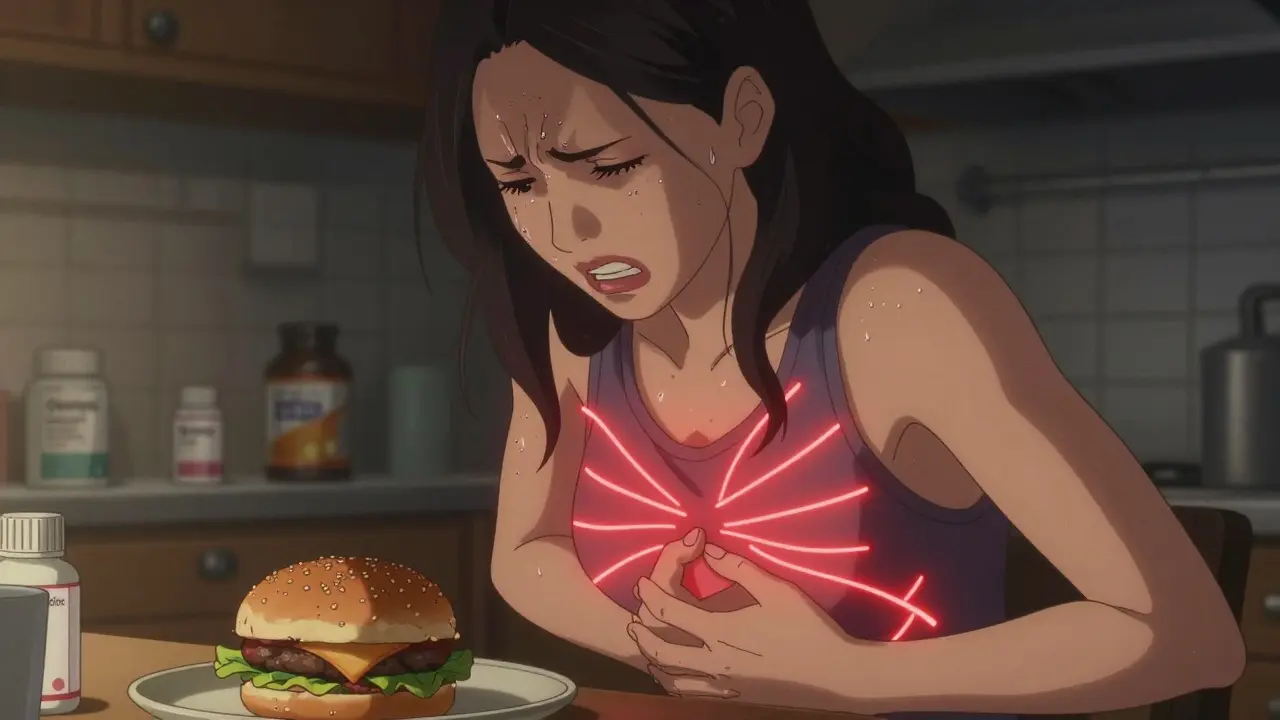
Most people on GLP-1 drugs get mild nausea or bloating at first. That usually fades. But if you feel this, don’t ignore it:- Right upper quadrant (RUQ) pain that lasts more than 30 minutes-this is the #1 red flag. In one study, 89% of people with acute cholecystitis had pain lasting longer than half an hour.
- Pain radiating to your right shoulder. That’s classic. It’s not muscle strain-it’s your gallbladder sending signals through shared nerves.
- Pain after eating fatty foods. A burger, fries, cheese, even a spoonful of butter. If your pain spikes right after, it’s a 94% match for gallbladder trouble.
- Nausea or vomiting with the pain. This combo increases your chance of cholecystitis by nearly 4 times.
- Fevers or jaundice (yellow skin or eyes). That means the bile duct is blocked. This is an emergency.
These aren’t random symptoms. A 2022 case series of 28 patients on GLP-1 drugs found 75% needed gallbladder removal. Half had symptoms within 6 months. Nearly all had them within a year.
Who’s Most at Risk?
Some people are walking into this risk blind. You’re at higher risk if you:- Are female, especially over 40
- Have a BMI over 30
- Are losing weight faster than 1.5 kg (3.3 lbs) per week
- Have had gallstones before
- Have type 2 diabetes with insulin resistance
One study found that rapid weight loss alone increases gallstone movement risk by over 4 times. That’s why doctors now recommend slowing weight loss to 0.5-1 kg per week for people with existing gallbladder issues.
What to Do If You Have Pain
Don’t wait. Don’t pop antacids. Don’t assume it’s "just the drug."- Stop eating fatty foods immediately.
- Call your doctor or go to urgent care. Say: "I’m on a GLP-1 agonist and I have right upper quadrant pain that started after eating fat. I’m worried about gallstones."
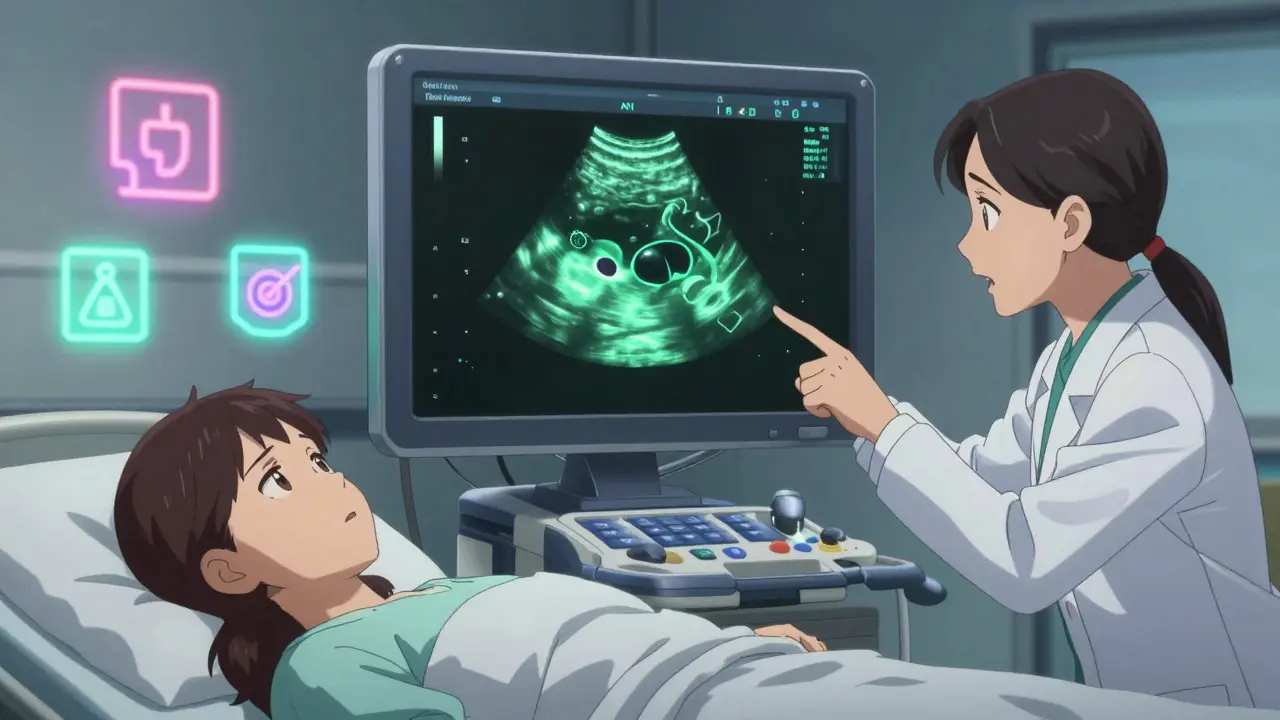
- Get an ultrasound. It’s quick, painless, and the best way to see stones or sludge.
- If stones are found, your doctor will likely stop your GLP-1 drug. In many cases, surgery (cholecystectomy) is needed. In one study, 75% of patients with GLP-1-related cholecystitis had their gallbladder removed.
Some patients worry: "If I stop, will I gain the weight back?" The answer? Yes, possibly. But gallbladder removal is a routine surgery with low risk. And you can restart GLP-1 drugs after recovery-just not until your gallbladder is gone. People without a gallbladder have almost no risk of new stones from these drugs.
What About People Who Already Had Their Gallbladder Removed?
Good news: if you’ve had a cholecystectomy, your risk drops dramatically. There’s no gallbladder to get blocked. You might still feel bloating or loose stools after fatty meals, but you won’t get gallstones or cholecystitis from GLP-1 drugs. This group can usually continue treatment safely.What’s Being Done to Fix This?
The FDA updated labeling for all GLP-1 drugs in January 2023 to include gallbladder warnings. The American Association of Clinical Endocrinology now recommends baseline ultrasounds for high-risk patients before starting treatment. Researchers are testing if a simple, cheap drug-ursodeoxycholic acid (UDCA)-can prevent stones. Early trials are promising. UDCA helps dissolve cholesterol in bile and keeps stones from forming. A phase 2 trial is currently enrolling 300 people on GLP-1 drugs to test this. Meanwhile, patient communities are speaking up. On Reddit and HealthUnlocked, hundreds report sudden RUQ pain after months on Wegovy or Ozempic. Many describe going from feeling great to needing emergency surgery in under a week.Bottom Line: Know the Signs, Act Fast
GLP-1 agonists are powerful tools. They save lives by lowering heart attack risk in diabetics and helping people lose weight they’ve struggled with for decades. But they’re not risk-free. Abdominal pain isn’t just a side effect-it can be your body’s warning that something serious is happening. If you’re on one of these drugs and feel persistent, fatty-food-triggered pain in your upper right abdomen, don’t brush it off. Get checked. An ultrasound takes 15 minutes. A gallbladder attack can take hours-and surgery takes days. The benefits still outweigh the risks for most people. But that only holds true if you catch problems early.Can GLP-1 agonists cause gallstones even if I’ve never had them before?
Yes. Even if you’ve never had gallstones, GLP-1 agonists slow gallbladder emptying, which lets bile sit and harden into stones. This risk is highest in people who lose weight quickly, are female, over 40, or have obesity. Studies show about 1% of people on weight-loss doses develop gallstones within the first year.
How soon after starting GLP-1 drugs do gallbladder problems usually appear?
Most cases show up between 3 and 9 months after starting treatment. The median time to symptoms is around 180 days. But some people report pain as early as 6 weeks, especially if they’re on higher doses or losing weight rapidly. The risk is highest in the first year.
Should I get an ultrasound before starting Ozempic or Wegovy?
If you’re female, over 40, have a BMI over 30, or have a history of gallstones or rapid weight loss, your doctor should consider a baseline ultrasound. It’s not required for everyone, but it’s recommended by the American Association of Clinical Endocrinology for high-risk patients. It’s a simple way to catch silent stones before they cause trouble.
If I get gallstones, do I need surgery?
Not always, but often. If stones cause symptoms like pain, nausea, or infection (cholecystitis), surgery to remove the gallbladder is the standard treatment. About 75% of patients with GLP-1-related cholecystitis end up having their gallbladder removed. Medications can dissolve small stones, but they take months and aren’t reliable when you’re on a GLP-1 drug.
Can I restart a GLP-1 agonist after gallbladder removal?
Yes. Once your gallbladder is removed, your risk of new stones from GLP-1 drugs drops to nearly zero. You may still experience mild digestive changes after fatty meals, but you won’t get gallstone attacks. Many patients safely resume treatment after recovery, especially if they’re still benefiting from the weight loss or blood sugar control.


So let me get this straight-we’re giving people drugs that turn their gallbladder into a fossilized soup pot, then acting shocked when it explodes like a bad burrito? 🤦♀️ I’ve seen folks on Ozempic go from glowing to grimacing in three weeks, and no one’s talking about the real issue: we treat weight like a villain to be vanquished, not a body to be understood. Gallstones aren’t a side effect-they’re a symptom of a system that prioritizes speed over safety. And now we’re gonna slap on a warning label like it’s a cereal box? Cute.
Meanwhile, the people who need this drug most-low-income diabetics, folks with PCOS, the over-40 women quietly dying of metabolic neglect-are the ones least likely to get ultrasounds or ask the right questions. We’re not fixing the problem. We’re just making it louder.
Also, if you’ve got a gallbladder and you’re losing 5 lbs a week on Wegovy? Honey, you’re not ‘crushing it.’ You’re playing Russian roulette with bile ducts. Slow. Down.
And yes, I’m the person who told my doctor to hold the drug after my shoulder started hurting. And yes, I’m still alive. And no, I didn’t gain it all back. I just learned to eat like a human again.
PS: UDCA trials? I’ll take the cheap pill over the billion-dollar hype any day.
Interesting that the risk jumps from 0.3% to 1.3% depending on dose. That’s a 4x increase. But the absolute risk is still low. I wonder if the real issue is how we’re prescribing these drugs-like they’re vitamins instead of pharmacologic tools with complex physiological side effects.
Most patients don’t know what cholecystokinin is. Most doctors don’t have time to explain it. So the warning gets lost in the ‘lose 20 lbs in 3 months’ hype.
Ultrasound screening for high-risk groups makes sense. But who pays for it? And how many primary care docs even think to order it?
Let me be blunt: this entire discussion is a classic case of medical overreach disguised as patient advocacy. GLP-1 agonists are among the most significant therapeutic advances in decades. To single out gallbladder risk-when the cardiovascular and metabolic benefits are so profound-is irresponsible. You’re playing into the hands of anti-obesity extremists who think fat people should just eat less and move more. The data shows a 1.3% absolute risk. That’s less than the risk of a car accident on your daily commute.
Furthermore, the suggestion that patients should undergo baseline ultrasounds is ludicrous. It’s not cost-effective. It’s not evidence-based at scale. And it creates unnecessary anxiety. If a patient develops RUQ pain, they get an ultrasound. That’s standard. Why over-medicalize a population that is already being pathologized?
Hey everyone-just wanted to say I’m so glad this post exists. I’ve been on Ozempic for 8 months and had that right-side pain after tacos. I thought it was just ‘the drug.’ Turned out I had sludge and a tiny stone. Got the ultrasound, stopped the drug for 2 weeks, started UDCA, and now I’m back on it at a lower dose. No more pain.
My doctor didn’t even mention gallbladder risk when I started. I had to Google it. So if you’re on one of these drugs and feel *anything* off after fat? Don’t wait. Don’t tough it out. Your body’s not being dramatic-it’s trying to tell you something.
Also, if you’ve had your gallbladder out? You’re golden. No worries. Just eat slowly. And maybe avoid 100% butter toast. 😅
You got this. And if you’re scared? DM me. I’m here.
💛
I am from India. My aunt took this medicine. She got pain. Then she went to doctor. Doctor said: remove gallbladder. She did. Now she is fine. But she is sad. She says: ‘I thought medicine would fix me, not take something away.’
I think: medicine is powerful. But body is also wise. We must listen.
The meta-analysis cited in JAMA Internal Medicine reports a relative risk increase of 37%, but the absolute risk remains low at approximately 1.3% for weight-loss doses. This is clinically meaningful but should not be overstated. The number needed to harm (NNH) is approximately 77, meaning 77 patients must be treated for one additional case of gallbladder disease to occur.
Moreover, the risk is dose-dependent and temporally associated with rapid weight loss, which is a known independent risk factor for cholelithiasis. Therefore, the drug is not the sole causative agent-it is a co-factor.
Recommendations for baseline imaging should be targeted to high-risk subgroups, as per AACE guidelines, rather than universally applied. This balances safety with resource efficiency.
Blimey, this is why I stick to the gym and a bit of cabbage. No drugs, no drama. You lot in the US are so quick to pop a pill instead of eating right. Gallstones? Sounds like you’ve been living on pizza and soda. Just stop being lazy.
And yes, I know what I’m talking about-I’ve got a degree in biology from Oxford. You’re welcome.
Okay but what if the FDA knew about this all along and just let it slide because Big Pharma paid them? I read somewhere that the same people who approved Ozempic also own stock in Novo Nordisk. And why is UDCA not FDA approved for this? Because they don't want you to fix it cheap. They want you to get your gallbladder cut out. That’s $20k surgery. That’s profit. That’s the system. I’m not taking it anymore. I’m going off the drug and going on a lemon water cleanse. And I’m telling everyone.
They’re lying. They always lie. You think your doctor cares? They get paid per script. I’m done.
Also I think my cat is spying on me. I saw her stare at my pill bottle yesterday. She knows.